
The first career arc — building an AI influencer brand from concept to cultural significance — is a defined strategic sequence. The second career arc is more complex, more open-ended, and potentially more valuable: the use of everything earned in the first arc — brand equity, audience trust, operational expertise, financial capital, and institutional relationships — to build something new from a position of established authority rather than from zero.
AI influencer second career strategy is not a reactive pivot made out of necessity. It is a proactive reinvention architecture that converts first-career assets into potential second-career launch advantages — accelerating the next venture, the next brand, or the next industry entry in ways that may be difficult for new entrants to reproduce quickly. The creator who approaches the second career strategically may build momentum from day one. The creator who approaches it without structure discovers that even significant first-career success does not automatically transfer.
This guide provides a complete framework for AI influencer second career development — equity leverage assessment, persona re-architecture, audience transfer engineering, infrastructure repurposing, narrative repositioning, partnership bridge networks, and multi-cycle career design. It extends the long term growth roadmap beyond the first arc into the sustained entrepreneurial career that maximises the value of everything built in round one.
The second career may begin after a full exit, partial sale, licensing agreement, succession transition, or gradual withdrawal from the original brand. The assets and restrictions available for redeployment depend on the exact exit strategy.
AI influencer second career strategy is the process of using the brand equity, audience trust, intellectual property, operating systems, professional relationships, and financial resources built during a successful first creator career to launch a new entrepreneurial, advisory, media, educational, investment, or creative career arc.
A strong AI influencer second career strategy helps creators reinvent without abandoning accumulated authority, transfer relevant audiences responsibly, reuse proven infrastructure, establish credibility in a new field, and create additional long-term commercial value from first-career assets.
What You Will Learn in This Guide
In this AI influencer second career strategy guide, you will learn:
- how to identify transferable assets from a successful first creator career
- how to choose adjacent opportunities without abandoning established brand equity
- how to evolve persona identity while preserving recognition and audience trust
- how to introduce an existing audience to a new professional direction
- how to reuse operating systems, partnerships, media relationships, and capital
- how second-career strategy connects to exit planning, wealth reinvestment, legacy brands, brand expansion, and long-term creator longevity

AI Influencer Second Career Strategy (Strategic Overview)
A second career is not a restart — it is a redeployment. The distinction is the difference between abandoning first-career equity and leveraging it. Most creators who attempt reinvention without strategic architecture make the restart mistake — treating the second career as if the first one had not happened, failing to systematically transfer the assets that give the second career its starting advantage.
An AI influencer brand expansion strategy grows the existing brand into adjacent niches, products, audiences, or markets while preserving the same primary business identity. An AI influencer second career strategy begins a new professional or entrepreneurial arc by selectively redeploying assets from the first career.
A wealth reinvestment strategy primarily governs post-exit capital. A legacy brand strategy primarily governs institutional continuity. Second-career strategy governs the creator’s next role, identity, authority position, and operating direction.
Research on founder role identity treats entrepreneurship as a role transition rather than only a business launch, reinforcing the need to manage identity, skills, networks, and persistence during reinvention. See INSEAD’s research on becoming a founder and entrepreneurial role transition.
Why strategic reinvention strengthens long-term creator longevity
Creator longevity is not about maintaining the same output indefinitely — it is about the capacity to evolve through multiple career arcs without losing the accumulated brand equity that makes each transition possible.
Creators who reinvent strategically may extend their productive career horizon because each successful arc can add authority, relationships, operating knowledge, and capital available for the next. The credibility built across the first career — institutional partnerships, press recognition, community trust, and peer acknowledgement — does not automatically disappear when the creator pivots. Some of it may transfer. The question is whether the reinvention is designed to capture relevant equity without overstating its applicability in the new field.
How leveraging existing brand equity accelerates new career growth
First-career brand equity may provide three specific advantages that new entrants do not yet possess:
- Audience trust inheritance — A relevant existing community may accelerate initial credibility, provided the new direction still serves genuine audience interests
- Institutional relationship access — Media contacts, brand partnership relationships, and peer networks may provide introductions in new industry contexts
- Capital efficiency — Financial capital from the first career may fund research, team development, and market validation without immediate external funding
These advantages can reinforce one another when ownership, audience relevance, contractual freedom, and strategic fit are confirmed. They are potential launch advantages across several areas — not guarantees that the second career will outperform a new entrant or the first career.
Core principles of pivoting without losing audience trust
Three principles govern responsible creator reinvention:
- Narrative continuity — The pivot should be framed as evolution rather than abandonment when the connection is genuine. Distant pivots may require a separate brand.
- Values consistency — The character’s core values and archetype should remain recognisable where the original identity continues to be used.
- Community involvement — Audiences invited into the reinvention through transparent communication and voluntary participation are more likely to understand the transition than audiences pressured to migrate.
Section takeaway: The second career is a selective redeployment of first-career equity, not automatically a fresh start or a guaranteed transfer. Ownership, relevance, credibility, and audience expectations determine what can responsibly move into the next arc.
AI Influencer Second-Career Pathways
| Second-Career Pathway | First-Career Assets Reused | Main Strategic Requirement |
|---|---|---|
| New creator brand | Audience insight, production systems, capital | Distinct positioning and validated demand |
| Venture studio founder | Operating expertise, team systems, IP experience | Portfolio governance and staged investment |
| Adviser or consultant | Authority, case studies, professional relationships | Demonstrable expertise and clear offer |
| Media or education business | Content library, thought leadership, audience trust | Owned distribution and curriculum architecture |
| Investor or strategic partner | Capital, industry intelligence, network access | Risk controls and disciplined evaluation |
| IP or licensing steward | Character rights, brand archives, commercial relationships | Legal protection and governance |
| Executive or institutional role | Leadership experience, media credibility, partnerships | Transferable operational competence |
These pathways can overlap, but each requires different positioning, operating systems, risk exposure, legal rights, and audience expectations. A creator may combine advisory work with a media business or venture studio, but overlapping roles should be governed clearly to prevent conflicts, overextension, and audience confusion.
Second-Career Decision Gate
Proceed only when there is evidence for:
- a clear reason for the new direction
- genuine founder or creator interest
- relevant audience or market demand
- transferable assets with documented ownership
- adequate financial and operational capacity
- a defensible authority-building pathway
- a transition plan for the original brand
- clear stop, revise, or separate-brand conditions
The U.S. Small Business Administration’s guidance on market research and competitive analysis recommends examining demand, market size, saturation, pricing, and competition before committing to a business direction.
Continuing the original brand, licensing it, appointing new management, or launching a separate brand may be better than repositioning the existing identity. The decision should reflect ownership restrictions, brand fit, audience expectations, available capital, and the creator’s willingness to build credible expertise in the new field.
Equity Leverage Assessment and Opportunity Mapping Systems
Before the second career direction is selected, a systematic assessment of the first career’s transferable assets identifies where meaningful leverage opportunities exist.
Evaluating transferable brand assets and intellectual property value
| Asset Category | Transferability | Second-Career Value |
|---|---|---|
| Audience trust and relationship depth | High when relevance remains | Potential initial credibility in a related niche |
| IP portfolio (character design, brand marks) | Ownership- and contract-dependent | Licensing, co-branding, or expansion opportunities |
| Media relationships and press access | Often transferable as introductions | Faster access to credibility-building opportunities |
| Community platform (email list, Discord) | Consent- and relevance-dependent | Distribution only for genuinely relevant offers |
| Operational systems and production infrastructure | Often high | Reduced setup cost for new ventures |
| Brand recognition and institutional authority | Category-dependent | Potential partnership access in adjacent fields |
| Financial capital from exit or ongoing revenue | Available only after obligations and restrictions | Venture capitalisation subject to risk controls |
The equity inventory determines which second-career directions offer stronger transfer potential — where valuable first-career assets are legally owned, operationally reusable, and relevant to the new direction.
Transferable asset audit:
- Which assets are legally owned by the creator or a controlled entity?
- Which assets depend on the original AI influencer character or its ongoing positioning?
- Which professional relationships are genuinely transferable to the new direction?
- Which audience segments are likely to have real interest in the new career?
- Which systems can be reused without major modification?
- Which expertise claims are supported by documented results?
- Which assets should remain with the first-career brand?
- Which restrictions arise from licensing, partnership, exclusivity, sale, earn-out, or succession agreements?
Brand recognition does not automatically make every first-career asset transferable. Ownership, consent, contractual rights, category fit, data permissions, and audience expectations must be reviewed before redeployment.
Identifying adjacent industries with strong growth potential
Second-career pivots into adjacent industries may offer stronger transfer potential than distant pivots because the creator’s existing expertise, audience profile, and brand positioning may remain relevant without requiring a complete identity rebuild. Adjacent niche scaling frameworks help identify intersections between the existing brand’s positioning and nearby markets, while second-career strategy determines whether the move is an extension or a genuinely new professional arc.
Research published in the Journal of Consumer Research indicates that perceived fit between a parent brand and an extension category influences consumer evaluation. See Consumer Reactions to Brand Extensions in a Competitive Context. This does not mean every adjacent opportunity will succeed; fit must be tested alongside demand, competition, credibility, and operating capacity.
Adjacent opportunity identification framework:
- Audience crossover assessment: which new industries serve overlapping audience needs without assuming every follower will transfer?
- Expertise transfer mapping: which new industry categories value the creator’s documented skills and operating experience?
- Brand extension logic: which directions feel like credible evolutions of the existing brand’s values and narrative?
- Market timing signal: which opportunities show validated demand rather than temporary attention alone?
Aligning reinvention goals with long-term entrepreneurial vision
The second career direction should be chosen not only for immediate opportunity but for its long-term strategic fit. Structured market research, audience interviews, pilot offers, and competitive analysis provide stronger evidence than intuition alone.
Strategic alignment checklist:
- ✅ The new direction aligns with the creator’s documented personal and professional objectives
- ✅ The pivot leverages relevant equity without misusing assets that belong to the original brand
- ✅ The new industry shows evidence of audience or customer demand
- ✅ The competitive environment and entry timing have been assessed
- ✅ The creator’s genuine interest, learning plan, and practical competence can sustain long-term delivery
A 5–10 year vision may be useful as an illustrative planning horizon, but it is not a universal requirement. The appropriate horizon depends on the pathway, market, creator goals, capital, and contractual commitments.
Section takeaway: The equity inventory is the map. Market validation and strategic fit are the decision criteria. Commit only after ownership, demand, authority-building, and transition risks have been examined together.
Persona Re-Architecture and Identity Transformation Frameworks
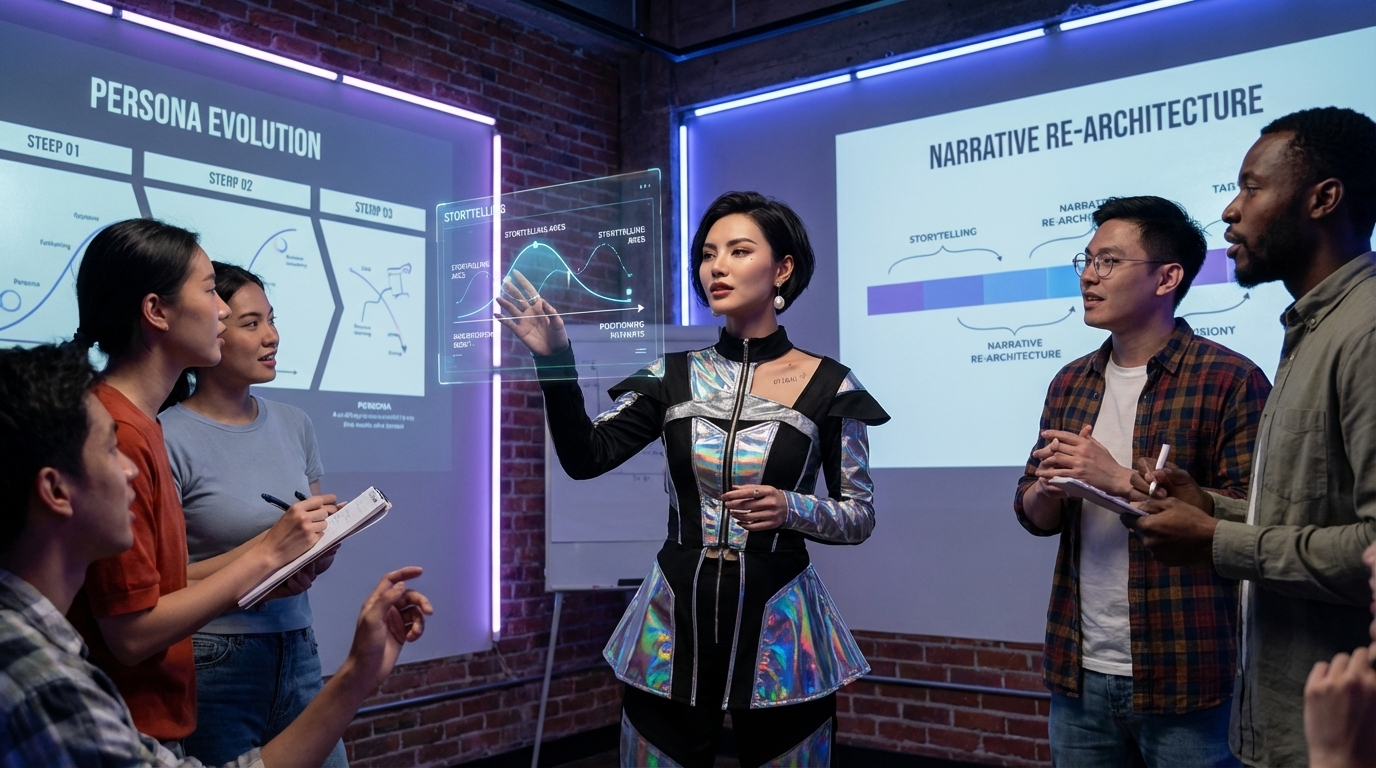
The second career requires narrative re-architecture — a deliberate redesign of the character’s identity presentation to reflect the new direction while maintaining the continuity that preserves relevant audience recognition.
Designing updated narratives that reflect new positioning directions
A well-constructed second chapter — framing the pivot as the natural result of the first chapter’s journey when that connection is authentic — may generate audience curiosity rather than confusion.
Narrative re-architecture framework:
- Define the “evolution moment”: the specific experience, achievement, or insight that explains the pivot
- Articulate the new mission: what the creator is building toward and why it matters to the intended audience
- Connect values across arcs: demonstrate how relevant first-career values appear in the second career
- Preview the journey: invite interested audience members into the new arc without implying an obligation to follow
Maintaining authenticity signals during brand evolution phases
Authenticity is maintained through truthful alignment between claims, competence, identity, and action — not through content stasis.
Authenticity maintenance checklist:
- The new direction is genuinely aligned with the creator’s interests, learning commitment, and practical work
- The character’s communication voice and values remain consistent where the same identity is retained
- The transition is narrated honestly rather than retrospectively pretending the pivot was always planned
- Community feedback is actively solicited and used without allowing popularity alone to determine professional direction
Balancing innovation with continuity to preserve recognition
Balance framework:
- Fix where appropriate: Core values, ethical boundaries, visual recognition signals, and communication principles
- Evolve: Content category, industry context, partnership profile, and platform emphasis
- Introduce: New expertise evidence, new collaborators, new vocabulary, and new operating capabilities
The audience may recognise the creator’s identity in the new context while still deciding independently whether the new direction remains relevant to them.
Audience Transfer Engineering and Retention Optimisation Strategies
Audience transfer — introducing an existing community to the second-career context without damaging trust — is one of the most sensitive phases of reinvention. Audience migration should be measured through relevance, retention, and engagement quality rather than raw transfer volume.
An audience retention strategy helps evaluate whether the transition gives relevant followers a reason to remain engaged without pressuring audiences whose original reason for following no longer applies.
Some followers may prefer the original brand and should not be pressured into supporting a direction unrelated to their original interest. Audience loss is not always a strategy failure; it may be evidence that the new positioning is becoming clearer.
Guiding existing followers through reinvention storytelling campaigns
Reinvention storytelling campaigns are structured content series that narrate the pivot progressively — introducing the new direction, explaining the reasoning, and inviting voluntary audience participation.
Reinvention storytelling campaign structure:
- Retrospective content — Celebrating the first career arc journey, acknowledging the community’s role, and signalling a new chapter
- Exploration content — First-person documentation of the creator’s engagement with the new direction
- Credibility-building content — Demonstrating learning, practical work, documented outcomes, and collaboration with qualified voices
- Community invitation content — Inviting relevant followers into the new chapter while maintaining access to or clarity about the original brand
An illustrative 60–90 day window may provide enough time to build narrative continuity without turning the transition into an indefinite campaign.
The appropriate transition period depends on the distance between the old and new positioning, publishing frequency, audience overlap, contractual restrictions, and the amount of evidence required to establish credibility in the new field.
Not all followers will transfer. Forcing migration can weaken trust, and separate channels or brands may be more appropriate for distant pivots. Audience consent, data permissions, and expectation management matter throughout the transition.
Creating engagement loops that stabilise audience confidence
During reinvention, audience confidence may be uncertain. Consistent, relevant content in the new direction — even at a lower production volume — may stabilise expectations more effectively than high-volume inconsistent output.
Confidence-stabilising engagement loops:
- Regular anchor content in the new direction demonstrating progressive competence
- Community Q&A sessions addressing audience questions about the reinvention honestly
- Behind-the-scenes content showing the creator researching, testing, and building in the new space
- Milestone acknowledgements sharing evidence of progress without overstating authority
Leveraging community advocacy to support transition momentum
Community advocacy activation:
- Early access — Interested community members receive early access to second-career content
- Founding member recognition — Early participants are acknowledged without creating pressure on non-participants
- Co-creation opportunities — Selected community members contribute where consent, expertise, and compensation are appropriate
- Referral mechanics — Recommendations are encouraged only when the new offer genuinely fits the referred audience
Section takeaway: Audience transfer is a deliberate, consent-aware campaign rather than an announcement or forced migration. The duration is situational, and retaining trust matters more than maximising transfer volume.
Infrastructure Repurposing and Ecosystem Adaptation Models
The operational infrastructure built during the first career — content production systems, analytics frameworks, community management workflows, partnership processes — is one of the most valuable potential assets in the second-career transition. Repurposing rather than rebuilding suitable infrastructure may reduce launch cost and setup time.
Scaling operations makes reinvention easier because documented workflows, team roles, asset libraries, financial controls, approval systems, and analytics dashboards can be adapted instead of rebuilt.
Reusing operational systems to accelerate new venture launches
Infrastructure repurposing assessment:
- Content production workflow: which elements translate to the new content category with adaptation?
- Analytics infrastructure: which performance metrics remain relevant, and which require new tracking frameworks?
- Community management system: which onboarding, moderation, and recognition processes apply directly?
- Email marketing infrastructure: which audience permissions and segments allow relevant second-career communication?
Optimising content workflows for emerging industry contexts
Workflow adaptation framework:
- Identify which formats the new industry audience expects and uses
- Map existing production capabilities to those formats and identify capability gaps
- Prioritise the most important capability gaps during the initial launch phase
- Document the adapted workflow before scaling to maintain quality consistency
New industry contexts may require format and tone adjustments rather than complete workflow reconstruction, but specialised fields can also require new compliance, review, qualification, data, or subject-matter systems.
Aligning partnership pipelines with reinvention objectives
Partnership transition framework:
- Audit existing partnerships for relevance and transfer restrictions
- Identify first-career partners operating in or adjacent to the new industry
- Design partnership bridge proposals that create genuine mutual value
- Initiate second-career-specific outreach to credible new-industry partners
Existing relationships may create introductions, but each new agreement must be evaluated on its own terms.
Narrative Genesis and Authority Repositioning Systems
The second career requires a new authority narrative — a documented, publicly demonstrated case for the creator’s competence in the new domain. First-career credibility may provide visibility and access, but it must be translated carefully rather than treated as automatic expertise.
Global brand authority can accelerate introductions, media access, and institutional credibility, but authority in one category does not automatically establish expertise in another. The new career still requires evidence, relevant work, recognised collaborators, and consistent delivery.
First-career success can provide visibility and access, but it does not automatically establish subject-matter expertise in a new industry. Second-career authority should be supported by relevant research, qualifications where appropriate, practical work, transparent learning, documented outcomes, and credible third-party validation.
Crafting thought leadership content that reinforces new expertise areas
Thought leadership development framework:
- Conduct a structured research and practical learning phase before publishing expert-level claims; 90 days may be an illustrative window, not a universal threshold
- Identify the topics where first-career experience provides a genuinely relevant and distinctive perspective
- Produce long-form reference content supported by evidence, practical work, and transparent limitations
- Engage with established voices in the new domain through interviews, collaboration, peer review, or cited references
Leveraging media exposure to validate reinvention credibility
Media validation strategy:
- Prepare a second-career press narrative that explains the transition accurately
- Pitch the reinvention story to relevant first-career contacts without presenting publicity as proof of expertise
- Target industry-specific publications for evidence-based contributions
- Use interviews and podcasts to demonstrate thoughtful competence while remaining transparent about the learning stage
Integrating analytics insights to refine positioning evolution
Second-career positioning is iterative — the initial direction is a hypothesis, and audience, market, operating, and commercial evidence refine it.
Second-career analytics monitoring priorities:
- Engagement and retention by topic in the new domain
- Audience growth source: existing community versus new audience
- Qualified enquiries and partnership interest from the new industry
- Media and third-party validation from relevant new-sector sources
- Conversion from content attention into meaningful actions such as subscriptions, applications, consultations, or purchases
Structured analytics reviews may help creators refine positioning more deliberately, but there is no responsible universal claim that they make repositioning 40% faster. The speed of refinement depends on data quality, publishing frequency, market feedback, expertise development, and the distance of the pivot.
Partnership Bridge Networks and Cross-Industry Collaboration Frameworks
The transition between career arcs may be accelerated by bridge partnerships — collaborations with individuals, brands, or organisations that have credibility in the new industry and a genuine reason to work with the transitioning creator.
Existing partnership relationships may create introductions, but new agreements must be reviewed for category relevance, exclusivity, audience fit, reputation risk, and whether the partner genuinely strengthens second-career credibility. A disciplined brand partnership strategy helps evaluate those factors before public collaboration.
Securing strategic alliances that support entry into new verticals
Bridge partners can support credibility transfer when an established voice in the new industry collaborates with the transitioning creator based on real expertise, useful contribution, and mutual value.
Bridge partner identification criteria:
- Credibility in the new industry
- Existing relationship or a credible route to introduction
- Audience overlap that is relevant rather than merely large
- Clear mutual value and appropriate compensation or benefit
- No material conflict with existing sale, licensing, exclusivity, or partnership obligations
Building credibility through collaborative brand initiatives
Cross-industry collaboration formats:
- Co-created content series — Multi-part content produced jointly with a qualified new-industry partner
- Expert interview series — Established figures contribute expertise while the creator demonstrates informed facilitation
- Joint product or service development — A carefully governed offer combining complementary capabilities
- Event co-hosting — Virtual or physical events positioning the creator alongside credible new-industry voices
Designing long-term partnership pipelines aligned with reinvention goals
Partnership pipeline design principles:
- Tier 1: high-authority partners whose association is supported by real strategic fit
- Tier 2: mid-tier collaborators with strong audience and capability overlap
- Tier 3: first-career partners extending into the second-career context where contractually permitted
- Exclusivity discipline: avoid agreements that restrict future positioning or create conflicts with the original brand
Compounding Asset Deployment and Venture Growth Acceleration
The second career is built not only on brand repositioning but on the disciplined deployment of financial and operational capital accumulated in the first career. A complete wealth reinvestment strategy determines how much post-exit capital is genuinely available for entrepreneurial risk after personal security, tax obligations, liabilities, and diversified long-term investments are addressed.
Second-career venture capital should never be assumed to be automatically available after an exit. Earn-outs, escrow, taxes, transaction adjustments, existing commitments, and personal financial needs may materially reduce deployable capital.
A brand portfolio strategy helps determine whether the second-career venture complements the original brand, competes for the same audience, creates reputational conflict, or introduces excessive operational concentration.
Reinvesting capital into scalable projects that reinforce new positioning
Second-career capital deployment priorities:
- Content production quality appropriate to the new field
- Education, qualifications, mentorship, and research that build genuine competence
- Team expansion with professionals who bring relevant new-industry expertise
- Audience and market validation before large-scale growth spending
Leveraging performance metrics to prioritise expansion opportunities
Second-career growth prioritisation matrix:
- Topics generating relevant engagement and retention → test deeper investment
- Partnership categories generating qualified new-industry relationships → evaluate for strategic fit
- Revenue streams showing repeatable commercial traction → assess unit economics before scaling
- Channels demonstrating efficient acquisition of relevant audiences → concentrate selectively without creating platform dependency
Creating financial flywheels that sustain second-career momentum
Possible second-career financial flywheel:
- Initial research and content investment attracts a relevant new-industry audience
- Audience and market response produce evidence about positioning fit
- Qualified partnerships or customer revenue fund carefully selected improvements
- Improved delivery may strengthen retention, referrals, and authority evidence
- Stronger evidence may support larger collaborations or new offers
- Additional capital is committed only when traction, margins, governance, and risk controls justify it
This cycle can support repeated value creation when conditions are favourable, but it is not automatic. A new venture can fail despite strong first-career assets, and capital should be staged against evidence.
Legacy Iteration and Multi-Cycle Career Architecture
The most sophisticated creator entrepreneurs may plan for multiple career cycles across a long creative life. The legacy brand architecture developed in the first career can provide repeatable governance, documentation, and continuity infrastructure for later arcs.
Designing frameworks that enable repeated reinvention across market cycles
Multi-cycle career architecture principles:
- Each career cycle has a documented purpose, review process, and possible exit or evolution conditions
- A 5–7 year horizon may be an illustrative planning example rather than a fixed cycle length
- Each cycle deliberately builds assets that may be useful later: audience relationships, IP, operational expertise, and financial capital
- Reinvention is treated as a strategic option, not a mandatory response to every market change
- The creator’s core values may provide continuity while roles, industries, and brands evolve
Strengthening long-term brand resilience through adaptive strategies
Brand resilience architecture:
- Identity depth: values and narrative documented deeply enough to guide change
- Community infrastructure: relationships and owned channels independent of a single content category
- IP portfolio: assets with clear ownership and governance across career arcs
- Institutional relationships: professional networks managed without assuming universal transferability
Preparing governance systems that support future creator transitions
Founder succession research distinguishes the first transition away from a founder from routine executive succession because founder attachment, ownership, identity, and continued involvement can shape the process. See Founder-CEO Succession and the Paradox of Entrepreneurial Success.
Career governance framework:
- Annual strategic review: formal assessment of the current career arc’s trajectory and alignment
- Advisory council: a small group of trusted advisers with relevant and diverse expertise
- Documented decision framework: criteria for evaluating pivot, separation, licensing, management, or continuation options
- Legacy documentation: ongoing records of strategic decisions, ownership, rationale, and outcomes

Section takeaway: Multi-cycle career architecture treats each arc as both a destination and a possible source of assets for future work. Documentation and governance may make later transitions more informed, but no career cycle guarantees the success of the next.
Common Mistakes in AI Influencer Career Reinvention
The most damaging second-career errors are those that waste first-career equity, overstate expertise, or damage audience trust through poor transition architecture.
Pivoting without validating audience demand or market opportunities
The confidence of first-career success can lead creators to overestimate the transferability of their positioning into new markets. A pivot into an industry where the creator’s audience has little meaningful overlap and where no validated demand exists may underperform regardless of production quality.
Abandoning core brand values during transformation phases
A creator who completely redesigns the original identity during a pivot may weaken the equity they are attempting to leverage. When the new direction is too distant to maintain honest continuity, a separate brand may be more credible than forcing the original identity to carry incompatible claims.
Neglecting operational readiness when launching new ventures
The potential speed advantage of a second career comes partly from reusable infrastructure — but only when that infrastructure is legally available, strategically relevant, and adapted before launch. Rushing into a new venture without operational, financial, compliance, or expertise readiness can undermine the authority narrative being established.
Future Trends in AI Influencer Career Evolution
Three developments may influence the AI influencer second-career landscape over the next decade.
Rise of multi-industry creator entrepreneurs building diversified empires
Some advanced creator entrepreneurs may operate across multiple industries using venture studio or portfolio models, with a personal or institutional brand serving as one authority anchor among several. Success will depend on governance, portfolio fit, team depth, capital discipline, and the ability to avoid audience and operating conflicts.
AI-powered brand transformation analytics and predictive positioning tools
Emerging analytics platforms may help creators model audience overlap, content response, commercial demand, and scenario risk before committing to a pivot. These tools can support decisions but cannot reliably predict authority, trust, market timing, or long-term business outcomes without high-quality data and human judgement.
Integration of lifelong learning systems into creator business models
Durable creator careers may incorporate continuing education, practical work, peer review, and industry immersion into their operating systems — enabling reinvention based on genuine capability development rather than strategic performance alone.
Frequently Asked Questions
How do AI influencers reinvent their brand after success?
AI influencer brand reinvention can follow a structured process: equity leverage assessment, persona re-architecture, audience transition planning, infrastructure adaptation, and authority repositioning. The process should begin with ownership, market demand, audience relevance, and expertise evidence rather than assuming first-career popularity will automatically transfer.
What is the best way to pivot into a new industry?
There is no universal best pathway. Adjacent industries may offer stronger transfer potential when expertise, audience needs, and brand fit overlap. Distant pivots may require a separate brand, longer credibility-building, different channels, or a new operating team. Demand validation, bridge partnerships, practical work, and transparent authority development are more reliable than announcing expert status early.
How long does second-career growth usually take?
There is no universal second-career timeline. An illustrative audience transition campaign may last 60–90 days, but establishing a credible new career can take shorter or longer depending on niche distance, audience overlap, qualifications, capital, market timing, publishing frequency, operational readiness, and the strength of documented results. First-career assets may accelerate some stages, but a 12–18 month outcome or comparison with a 3–5 year new-creator timeline should not be treated as a benchmark or guarantee.
Can reinvention increase long-term revenue potential?
Reinvention may expand long-term commercial opportunities by opening new audiences, partnerships, products, advisory work, IP, or ventures. It can also introduce execution costs, reputational risk, audience loss, capital concentration, and opportunity cost. Multiple reinventions do not consistently guarantee greater total career revenue; results depend on strategic fit, competence, timing, governance, and market demand.
Conclusion — Turning Initial Success into Continuous Creator Evolution
The AI influencer second career strategy outlined in this guide is a strategic architecture for converting relevant first-career assets into a new professional or entrepreneurial arc without assuming that authority, audience, or commercial success transfers automatically.
Every framework described — equity leverage assessment, persona re-architecture, audience transfer engineering, infrastructure repurposing, narrative repositioning, partnership bridge networks, compounding asset deployment, and multi-cycle career design — contributes to a reinvention system that may become more informed and resilient with each cycle of application.
Creator entrepreneurs who build enduring careers are not defined only by the success of the first arc. They are defined by how responsibly they evaluate ownership, audience trust, expertise, infrastructure, capital, and identity before choosing what comes next.
Begin the next arc from a position of evidence. Build the transition with deliberate architecture. Redeploy only the assets that genuinely fit. The result is not a guaranteed second-career success — it is a stronger foundation for responsible reinvention and repeated value creation.
Complete the AI Influencer Growth Roadmap
Second-career strategy extends the creator journey beyond one successful brand, but the appropriate next move depends on which assets remain owned, which obligations continue after exit, and whether reinvention should occur through the original identity, a separate brand, an advisory role, or a new venture.
👉 Return to: AI Influencer Growth Roadmap — review the complete journey from positioning and audience growth to monetisation, global authority, digital empire development, legacy planning, exit preparation, wealth reinvestment, and creator reinvention.
Continue Learning
Explore the full AI influencer strategy ecosystem:
- 🗺️ Long Term Growth Roadmap — The complete strategic framework for building a compounding AI influencer business
- 💰 Capital Redeployment System — Structure the financial architecture that may fund second-career venture launches
- 🏛️ Legacy Brand Architecture — Build the institutional infrastructure that supports governance and continuity across career arcs
- 📈 Adjacent Niche Scaling — Map adjacent opportunities that may offer stronger transfer potential
- Exit Strategy — Understand which assets, rights, restrictions, and responsibilities remain after a sale, licence, or succession transition
- Scaling Operations Strategy — Adapt documented systems, team roles, and operating controls for the new career arc
- Brand Portfolio Strategy — Evaluate strategic fit, audience overlap, and concentration across the original and second-career brands
- Audience Retention Strategy — Protect trust while introducing an established audience to a new direction
Learning how to build an AI influencer second career strategy is one of the most important steps toward preserving first-career brand equity, transferring relevant authority responsibly, launching new ventures with stronger infrastructure, protecting audience trust, and creating long-term creator career value.