
The difference between a post that reaches 500 people and one that reaches 50,000 is often not content quality — it’s timing. Publish at the wrong hour and even your best Reel gets tested against a near-empty audience, earns minimal early engagement, and stalls before the algorithm has a chance to distribute it. Publish at the right hour and that same post accumulates the engagement velocity required to break into non-follower feeds.
Your AI influencer posting schedule is one of the highest-leverage adjustments you can make as a new creator — yet it remains one of the most consistently overlooked. Most beginners spend their energy on character design and content quality while treating posting time as an afterthought. The result is strong content that repeatedly underperforms simply because it was published during low-activity windows.
This guide covers everything you need to build a data-driven posting schedule for Instagram and TikTok in 2026: optimal time windows, recommended weekly frequency by growth phase, a plug-in daily plan template, an A/B testing framework, and the automation tools that make consistency achievable for a solo creator. If you’re still setting up your account foundation, start with our guide on how to become an AI influencer before diving into schedule optimisation.
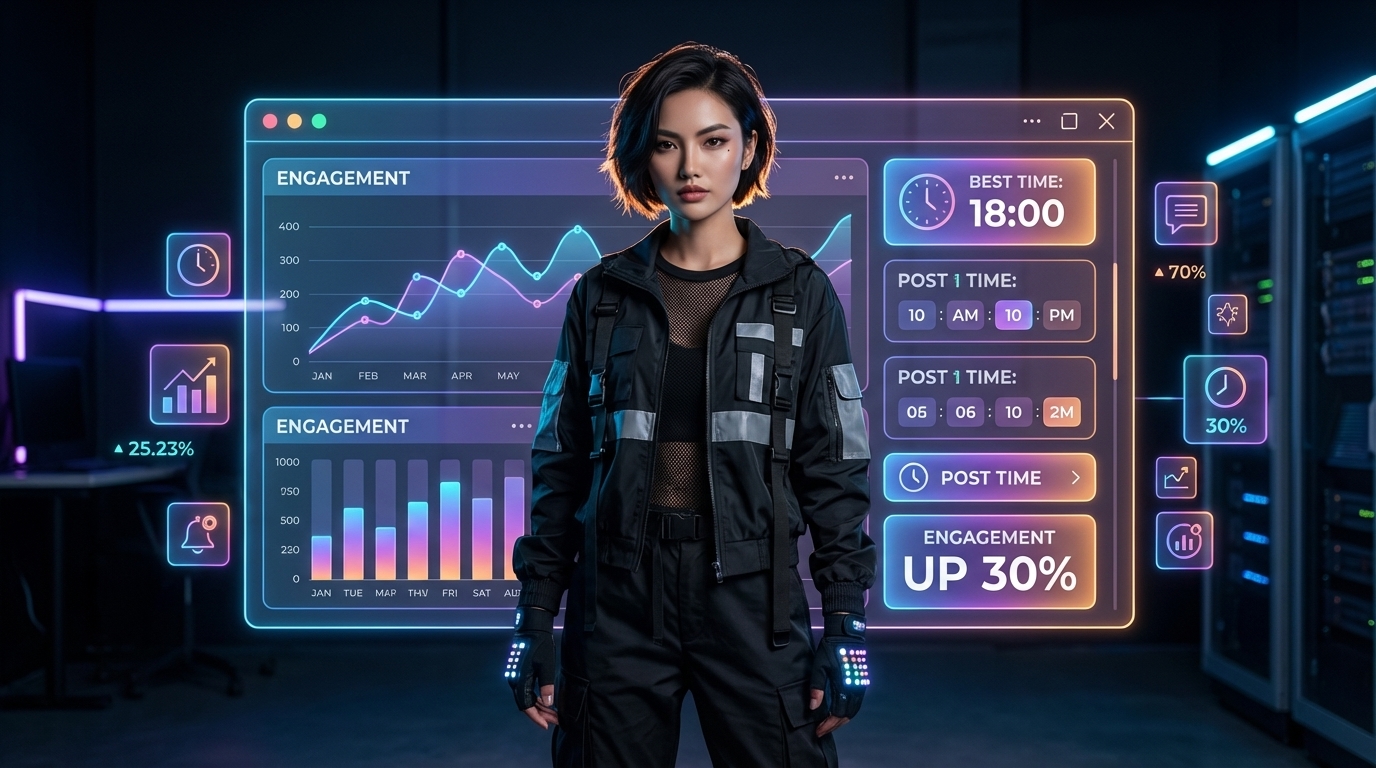
Why Your AI Influencer Posting Schedule Matters More Than You Think
How Platform Algorithms Respond to Timing
Every major social platform evaluates new posts using the same core mechanism: publish, test against a small initial audience, and measure the speed of engagement accumulation in the first 30 to 60 minutes. If that early engagement velocity meets the platform’s threshold for the account’s size and niche, the post earns wider distribution — including to non-followers.
Posts published during peak activity windows encounter more active users in that critical first hour, accumulate engagement faster, and pass the algorithmic threshold more reliably than equivalent posts published during quiet periods. The performance gap is larger than most creators expect: the same Reel published at 7pm on a Tuesday can earn two to three times the reach of the identical Reel published at 2pm on a Monday.
For the data behind this, best time to post on Instagram research from Later consistently shows measurable reach differences between optimal and suboptimal publishing windows — even for accounts at the same follower level.
How Posting Frequency Builds Long-Term Reach
Frequency affects growth through two distinct mechanisms:
Topic authority signal. Platforms build a stronger algorithmic category classification for accounts that post consistently within the same niche. An account that posts three times per week in the same niche for 90 consecutive days earns a topic signal that improves how each new post is pre-distributed before any engagement data accumulates.
Compound reach. Each consistently performing post leaves an authority residue that slightly raises the distribution baseline of the next post. This compounding effect is why accounts posting consistently for 60 to 90 days almost always show a growth acceleration curve rather than linear growth — the baseline reach of month three is meaningfully higher than month one.
The Two Scheduling Mistakes Beginners Make
Mistake 1: Publishing when content is finished, not when the audience is active. Most batch production sessions finish late at night or on weekend mornings — both suboptimal windows. Scheduling tools that publish automatically at preset times solve this entirely.
Mistake 2: Treating all content formats as equal for timing purposes. Reels depend on high-activity windows because reaching non-followers requires peak early engagement velocity. Carousels are more forgiving because their save-driven distribution is more gradual. The schedules below reflect these format-specific differences.
Best Posting Times for Instagram AI Influencers
Instagram’s engagement patterns in 2026 show three consistent daily peaks: a morning window driven by pre-work and commute scrolling, a midday window driven by lunch break activity, and an evening window driven by post-work browsing. UK and European audiences: use UK time as your reference. US audiences: prioritise Eastern time, which captures the largest US social media segment.
Morning Window (7am – 9am Weekdays)
The morning window captures two segments simultaneously: early risers checking their phones before the day starts (high engagement intent, unhurried browsing) and commuters scrolling during transit (high consumption volume). Reels published here benefit from an extended accumulation period across the full active morning.
For AI influencer accounts with an aspirational lifestyle or productivity focus, morning is especially strong because the content category aligns with the audience’s mindset. A morning routine Reel published at 7:30am reaches an audience in exactly the mental state that content is designed for — which improves both engagement rate and save rate relative to the same post published in the evening.
Evening Peak (6pm – 9pm Weekdays)
This is the highest overall engagement window for most AI influencer niches. Post-work scrolling is characterised by longer session lengths and higher save rates — users browse without time pressure, which means they watch full videos, swipe through full carousels, and save content for later.
For Reels specifically, 7pm to 8pm is the single highest-performing posting slot across most Instagram niches in 2026. Content published here benefits from the full evening engagement wave, earning the widest non-follower distribution of any time window.
Weekday vs. Weekend Performance
Weekday posts (Tuesday through Friday) earn higher non-follower reach because algorithmic distribution mechanisms are most active during high-platform-engagement periods. Monday is the exception — morning engagement is significantly lower than Tuesday through Friday as users re-enter work mode.
Weekends are different by content type rather than uniformly stronger or weaker:
- Saturday and Sunday earn higher save rates on lifestyle, recipe, and aspirational content — users in leisure mode save more ideas.
- Educational and tutorial content performs better on weekdays when audiences are in a learning mindset.
Instagram Weekly Schedule (Recommended)
| Day | Time | Format |
|---|---|---|
| Tuesday | 7:30am | Reel — educational or lifestyle |
| Wednesday | 7pm | Carousel — quick tips or authority content |
| Thursday | 7:30am | Reel — transformation or trending audio |
| Friday | 6:30pm | Engagement post — poll, Q&A, or opinion |
| Saturday | 10am | Lifestyle or aesthetic post — aspirational content |
Best Posting Times for TikTok AI Influencers
TikTok distributes content to non-followers from the very first post, making it the most forgiving platform for new accounts in terms of initial reach. Timing still matters significantly, however — it determines the ceiling of each post’s distribution and the speed at which follower growth compounds. Understanding TikTok algorithm distribution mechanics helps clarify why the windows below outperform others consistently.
TikTok’s engagement peaks broadly align with Instagram’s but with key differences driven by its younger average demographic and higher proportion of evening-only users.
Afternoon Discovery Window (2pm – 5pm)
TikTok’s afternoon window is driven primarily by the 16-to-24 demographic whose active browsing peaks in the early-to-mid afternoon rather than morning. For AI influencer accounts targeting fashion, beauty, trending challenges, study motivation, or creative hobby content, the afternoon window is stronger than the equivalent Instagram morning window.
The 3pm to 4pm slot specifically benefits from TikTok’s mid-afternoon For You Page refresh cycle, which surfaces newly published content from accounts in the algorithm’s topic category to users who haven’t seen content from those accounts that day.
Evening Viral Surge (7pm – 11pm)
TikTok’s evening window is its highest-volume activity period — highest daily active user count, longest average session lengths, and most viral distribution events. Reels published between 7pm and 9pm on weekdays are tested against the platform’s largest available daily audience.
For accounts prioritising viral growth events — the occasional breakthrough post earning 10x or 100x normal reach — Tuesday, Wednesday, or Thursday at 7pm to 9pm is the highest-probability publishing slot available. These days represent the intersection of the week’s peak TikTok engagement and its highest algorithmic distribution activity.
Cross-Platform Repurposing: Remove Watermarks
TikTok suppresses watermarked content from competitor platforms, reducing reach by 30 to 50% compared to clean versions. Always remove Instagram watermarks before cross-posting. CapCut’s export settings produce clean, unmarked video files by default, making it the recommended editing tool for accounts managing both platforms.
TikTok’s algorithm also rewards posting consistency more aggressively than Instagram’s. An account posting once daily for 30 consecutive days builds a significantly stronger topic signal than one posting seven times in week one and then sporadically.
TikTok Weekly Schedule (Recommended)
| Day | Time | Format |
|---|---|---|
| Monday | 3pm | Repurposed Instagram Reel — adapted caption, no watermark |
| Tuesday | 8pm | Original Reel — highest-production, best hook of the week |
| Wednesday | 3pm | Educational tip or quick tutorial |
| Thursday | 8pm | Trending audio or challenge format |
| Friday | 7pm | Personality or storytelling content |
| Saturday | 12pm | Lifestyle or aesthetic post |
| Sunday | 7pm | Community engagement or Q&A response |

Ideal Weekly Posting Frequency for AI Influencers
Posting frequency has the most consistent direct impact on AI influencer account growth rate in the first six months. More frequent posting builds topic signal faster, generates more performance data for analysis, and keeps the account visible during the critical early months when audience recognition is being established.
The targets below are calibrated for solo creators using AI production tools. Without tools, these volumes are unsustainable at consistent quality.
Frequency Targets by Growth Phase
Growth phase (0 – 10K followers)
- Instagram: 3–5 feed posts/week + daily Stories
- TikTok: 3–7 posts/week
Scaling phase (10K – 50K followers)
- Instagram: 4–5 feed posts/week + daily Stories
- TikTok: 5–7 posts/week
Established phase (50K+ followers)
- Instagram: 3–4 feed posts/week + daily Stories
- TikTok: 4–5 posts/week — quality optimisation over volume
The minimum effective frequency for the growth phase (3 Instagram feed posts + 3–5 TikTok posts per week) is the floor required to build a consistent algorithmic topic signal within 60 to 90 days. Below this, growth timelines extend significantly. For the accelerated schedule (5 Instagram feed posts + 7 TikTok posts), accounts with strong hook strategy typically reach 10,000 followers on at least one platform within 90 to 120 days.
Balancing Quality and Consistency
The tension between quality and consistency resolves through AI production tools that raise the quality floor of high-volume output. A HeyGen avatar video produced in 15 minutes is consistently more polished than most selfie videos; a Midjourney character image produced in three minutes is consistently more visually compelling than most smartphone photos.
Apply this minimum quality standard before publishing any post:
- A hook that took at least five minutes to refine
- Imagery generated from saved character reference prompts (ensures visual consistency)
- A caption with a specific call-to-action
Any post meeting all three is publishable. Any post that doesn’t should be revised before it goes out — never rush to meet a frequency target at the expense of these basics.
When to Increase Posting Volume
Increase your weekly frequency when any of the following conditions are true:
- Your Reel watch-through rate exceeds 50% consistently (hook strategy is working)
- Your carousel save rate exceeds the platform average for your niche (educational content is resonating)
- You’ve established a batch workflow that reliably produces one week of content in a single 3–4 hour session
Never increase volume in response to poor performance alone. Posting more weak content signals to the algorithm that the account produces weak content — which negatively affects distribution for all future posts. Increase volume only when quality and engagement rate justify it.
For more detailed AI influencer growth hacks that compound follower acquisition month over month, see our dedicated growth strategy guide.
Simple Daily Posting Plan Template
The plan below is built for a beginner AI influencer account managing Instagram and TikTok simultaneously at the minimum effective frequency on both platforms. It is designed to run from a single weekly batch production session. For a complete month-by-month breakdown mapped across four weeks with specific formats and topics for each slot, see our AI influencer weekly content calendar.
Short-Form Video Rotation (Reels + TikToks)
Short-form video is the primary reach driver and should anchor the weekly schedule. This rotation produces 3 Instagram Reels and 5 TikTok posts per week using a mix of original content and platform-adapted repurposes:
- Monday — TikTok only: repurpose last week’s best-performing Instagram Reel. Adapted caption, watermark removed.
- Tuesday — Instagram Reel (7am or 7pm) + TikTok original (8pm). Your highest-hook content of the week on both platforms.
- Wednesday — TikTok only: educational tip or quick tutorial (3pm).
- Thursday — Instagram Reel (7:30am) + TikTok (8pm): trending audio or transformation format.
- Friday — TikTok only: personality or storytelling content (7pm).
- Saturday — Instagram feed post (10am): lifestyle or aesthetic. TikTok (12pm): same content, adapted caption.
- Sunday — TikTok only: community engagement or Q&A response (7pm). Rest from Instagram feed posting.
Carousel and Educational Post Timing
Carousels are the highest-save format on Instagram and should publish during mid-week when save behaviour peaks. Wednesday and Thursday evenings (6pm to 8pm) are the strongest carousel windows across most niches — users are more likely to save reference content mid-week than on weekend days when leisure browsing dominates.
Schedule two carousels per week:
- Educational/tutorial carousel (quick tips, workflow breakdown, myth-busting) — publish Wednesday or Thursday for maximum save rate
- Authority/storytelling carousel (opinion post, series instalment, character development) — any weekday works; its primary signal is comments and shares rather than saves
Story Engagement Sequence
Stories maintain daily algorithm presence in the Stories bar of existing followers without requiring full feed post production effort. Post 3–5 Stories per day regardless of whether a feed post publishes that day — this daily presence maintains the engagement consistency signal that platforms use to assess account reliability.
Structure each day’s Stories around three types:
- 7am – 9am: Morning content preview or character lifestyle moment
- 12pm – 1pm: Interactive Story using a poll or question box (captures lunch break engagement)
- 7pm – 8pm: Evening reminder or CTA pointing to the day’s best feed post or bio link
This three-Story sequence takes under 15 minutes to produce in Canva and can be batched for the full week in a single 45-minute session. For more content ideas for AI influencers across all formats, see our dedicated content strategy guide.
How to Test and Optimise Your Posting Schedule
Generic posting time benchmarks are a reliable starting point — but your specific audience may be active at different times from the global average. A systematic A/B testing approach using your own account’s performance data will consistently outperform any generic benchmark within 60 to 90 days. Research on social media engagement benchmarks from Buffer highlights how significantly engagement rates vary by account, niche, and audience — reinforcing why personalised data is more reliable than global averages.
A/B Testing Posting Times
To A/B test posting times, publish two Reels with equivalent hooks and production quality at two different time slots within the same week. Compare engagement velocity at the 1-hour, 6-hour, and 24-hour marks. Track watch-through rate, save rate, and profile visits for each post.
After three to five test pairs, a clear pattern typically emerges. Run one A/B test per week during the first 60 days:
- Begin with the benchmark windows from this guide
- Then systematically test adjacent slots — if 7pm beats 7am, test 6pm vs. 7pm vs. 8pm in subsequent weeks
- The resulting schedule is account-specific and audience-specific — more reliable than any generic benchmark
Four Metrics to Track Per Post
Build a posting schedule performance dataset by logging these four metrics for every post:
| Metric | Best Format | What It Tells You |
|---|---|---|
| Watch-through rate | Reels | Hook quality + timing alignment |
| Save rate | Carousels | Educational value + audience intent |
| Profile visits generated | Both | Discovery reach effectiveness |
| Follower change (24hr post) | Both | Net growth impact of the post |
After 30 posts of consistent tracking, patterns linking specific posting times to specific performance levels become statistically visible. These patterns are your personalised optimal schedule.
Monthly Schedule Review Process
At the end of each month, make three targeted adjustments:
- Update the posting time of your lowest-performing slot to a new, previously untested window
- Maintain the posting times of your two highest-performing slots without change
- Adjust Story posting times if Story completion rates are declining — a declining completion rate often means Stories are publishing when fewer active followers are online
Cross-reference your manual A/B test data with Metricool’s best-time-to-post feature, which calculates optimal windows based on your account’s own historical engagement data. Check the Metricool recommendation monthly — if it aligns with your manual data, your schedule is well-optimised; if they diverge, investigate which posts are creating the discrepancy.
Automation Tools to Maintain Consistent Posting
Posting consistency is the most important variable in schedule effectiveness — and the most vulnerable to real-life disruption. A scheduling automation system eliminates the daily decision of when and whether to post, converting a potentially inconsistent manual practice into a reliable automated system that runs with or without active daily management.

Best Scheduling Tools for Beginner AI Influencer Accounts
Buffer — Best for multi-platform management
- Free plan supports three connected social channels
- Built-in AI caption assistance
- Best-time-to-post recommendations based on your account’s historical data
- Auto-publishes to Instagram, TikTok, Facebook, Pinterest, and LinkedIn from one dashboard
Later — Best for Instagram-first accounts
- Visual grid preview lets you verify feed aesthetic coherence before publishing
- Especially valuable for AI influencer accounts where visual brand consistency is a strategic priority
- Full cross-platform scheduling support
For the complete tool stack that powers a professional AI influencer production and scheduling system, see our guide to the best AI influencer tools in 2026.
Weekly Scheduling Workflow
Set up a fixed weekly scheduling session immediately after your content production session. The process takes 20 to 30 minutes for a full week of content across both platforms:
- Import all produced content into your scheduling tool
- Assign each post to its optimal time slot based on this guide (or your personalised A/B test results)
- Apply hashtag stacks and captions
- Activate the queue — no further daily management required
Why Batch Publishing Outperforms Post-by-Post Scheduling
Batch publishing — scheduling a full week or full month of content in a single session — provides two advantages beyond time efficiency:
Coherent calendar planning. When scheduling a full week simultaneously, you can verify that no two high-investment posts are scheduled within 12 hours of each other (which splits algorithmic distribution impact), and ensure the week’s content covers all five content format categories rather than clustering in one format.
Decoupled production and publication timing. Production sessions that run until late evening regularly produce excellent content that gets published at 11pm without batch scheduling in place. Batch scheduling ensures every post publishes at an optimal window regardless of when it was produced.
Cross-Platform Distribution Priority Order
A systematic cross-platform approach maximises the reach of every piece of content without requiring full platform-specific creation. The recommended workflow:
- Instagram → TikTok (24–48 hours later): Publish every Reel on Instagram first, then cross-post to TikTok with a platform-specific caption. The stagger prevents duplicate content flags while maximising total reach.
- Instagram → YouTube Shorts: Repurpose your three highest-retention Reels per week as Shorts. YouTube’s Google search indexing provides long-tail reach that social platforms cannot match.
- Carousels → Pinterest: Repurpose your two best carousels as Pinterest pin series. Lifestyle and educational niches earn strong Pinterest search traffic.
- AI tutorials → LinkedIn: Professional productivity content reaches a higher purchasing-intent audience on LinkedIn, especially for B2B-adjacent AI creator content.
Frequently Asked Questions
How often should AI influencers post?
The minimum effective frequency for a beginner AI influencer account is 3 Instagram feed posts per week plus daily Stories, and 3–5 TikTok posts per week. This builds a consistent algorithmic topic signal without exceeding solo creator production capacity. For accelerated growth, 5 Instagram feed posts plus daily Stories and 7 TikTok posts per week is the target schedule — accounts with strong content quality at this frequency typically reach 10,000 followers within 90 to 120 days.
Never increase posting frequency beyond your capacity to maintain current content quality. Quality degradation from over-extension slows growth faster than lower posting frequency.
What is the best time to post AI influencer content?
The highest-performing generic windows in 2026 are:
- 7am – 9am weekdays: Morning engagement window — strongest for Reels and aspirational content
- 12pm – 1pm weekdays: Lunch break window — strongest for carousels and educational content
- 6pm – 9pm weekdays: Evening peak — the strongest overall window across all formats and both platforms
The 7pm – 8pm slot on Tuesday through Thursday is the single highest-performing posting time across most AI influencer niches. These are starting benchmarks — 60 days of A/B testing will produce a personalised optimal schedule that outperforms any generic recommendation.
Can beginners grow without daily posting?
Yes. Three feed posts per week on Instagram plus daily Stories is the minimum effective growth schedule and is achievable without daily content creation. Daily Stories can be batched for the full week in a single 45-minute Canva session and scheduled automatically through Buffer or Later.
Daily posting is more valuable on TikTok than Instagram for growth-phase accounts — but “daily TikTok presence” does not require daily production. It requires daily publishing, which automated scheduling handles after a single weekly production session using repurposed Instagram content.
Do posting times change by niche?
Yes — niche determines the demographic and behavioural profile of your target audience, which directly affects optimal posting times:
- Productivity and study motivation: Morning windows (7am – 9am) — audience is in a goal-oriented mindset
- Fashion and lifestyle: Evening windows (7pm – 9pm) — audience is in leisure browsing mode
- Food and recipe: Weekend mornings and evenings — aligns with meal planning and cooking activity
These patterns are consistent enough to inform starting schedule decisions, but always validate against your own account data within the first 60 days.
Next Step: Build Your Complete AI Influencer Growth System
An optimised AI influencer posting schedule is a powerful growth multiplier — but it amplifies strong content; it cannot compensate for weak content, an undefined niche, or an underdeveloped character identity.
You now have the timing foundation that ensures every piece of content you produce reaches the largest possible initial audience. The next step is combining it with the content formats, hook strategy, and platform growth tactics that make the content itself worth discovering.
Start with the AI influencer weekly content calendar to map your posting schedule across a full month with specific formats and topics for every slot. Then use the AI influencer tools guide to build the scheduling and production stack that makes your posting system run on autopilot. And when you’re ready to connect schedule, content strategy, niche selection, and monetisation into a single compounding growth system, the full framework is in our pillar guide on how to become an AI influencer in 2026.
Your schedule is set. Now go build something worth discovering.