
A clear AI influencer content strategy is the difference between an account that grows steadily and one that produces content for weeks without gaining meaningful traction. The tools available in 2026 make it possible for any beginner to create professional-quality posts, Reels, and carousels — but without a plan governing what to post, when to post, and how to build on previous content, even great individual posts fail to accumulate into a growing audience.
Most beginner AI influencer accounts make the same set of mistakes: posting inconsistently when inspiration strikes, producing content across too many unrelated topics, skipping short-form video in favour of easier static posts, and never reviewing analytics to understand what is actually working. Each of these mistakes is fixable — but each one compounds over time, and the accounts that address them earliest grow the fastest.
This guide provides a 30-day AI influencer content strategy that beginners can follow from day one: four weeks of structured activity covering persona building, batch content creation, platform optimisation, and community engagement. A strong AI influencer content strategy is what separates accounts that compound their growth month over month from those that plateau after the first few weeks. It also includes 30 ready-to-use content ideas, a repurposing workflow, and a monthly analytics checklist — everything needed to turn a new AI influencer account into a consistently growing presence.

Why a Strong AI Influencer Content Strategy Drives Consistent Growth
Content strategy is the operational framework that converts individual posts into cumulative brand growth. Without it, each piece of content exists in isolation. With it, every post builds on the previous one — reinforcing your niche authority, training the algorithm on your content category, and giving your audience a consistent reason to follow and return.
How consistency drives algorithm visibility
Every major platform — Instagram, TikTok, YouTube — uses posting consistency as a signal in its content distribution algorithm. Accounts that publish on a regular, predictable schedule are treated as reliable content sources and receive broader distribution for each post. Accounts that post sporadically are deprioritised, regardless of individual post quality.
For a new AI influencer account, this means that four average posts published on a consistent schedule will almost always outperform one excellent post published with no follow-up. The algorithm rewards the pattern of behaviour, not just the individual piece of content. Consistency is the compounding mechanism that makes every subsequent post worth more than the last.
Benefits of structured content planning
A structured content plan delivers three practical advantages beyond consistency. First, it eliminates creative decision fatigue — when your topics, formats, and posting days are pre-defined, each production session is execution rather than invention. Second, it ensures content variety — a plan prevents your feed from becoming dominated by a single content type, which limits both reach and audience retention. Third, it creates a data foundation — when content is planned and posted systematically, analytics become interpretable. You can identify what works because the variables are controlled.
Common content strategy mistakes beginners make
The most damaging beginner mistakes are predictable and preventable:
- Posting without content pillars — results in an unfocused feed that is hard for the algorithm to categorise and hard for new visitors to understand
- Ignoring short-form video — Reels and TikToks drive the majority of new follower growth on both platforms; skipping them dramatically slows audience expansion
- Treating every post as standalone — not building narrative threads or recurring formats means no compounding audience loyalty
- Reviewing analytics monthly instead of weekly — monthly review is too slow to catch and correct underperforming content patterns before they set in
- Changing strategy too frequently — most beginners abandon a content approach before it has had enough time to generate meaningful data
Core Content Pillars for AI Influencer Growth
Content pillars are the three to five recurring themes that anchor your entire content calendar. Every post you produce maps to one pillar, ensuring your feed has strategic coherence and that your account consistently signals its niche to the algorithm. The four pillars below form the foundation of the most effective AI influencer content strategies in 2026.
Lifestyle and personality content
Lifestyle and personality content is the primary reach and follow-conversion driver for AI influencer accounts. This is the content that new visitors see first and that communicates who your character is and what aesthetic world they inhabit. Fashion imagery, stylised scene posts, day-in-the-life Story content, and personality-driven captions all fall under this pillar.
This pillar should account for 25–30% of your weekly content output. It does not need to deliver hard information — its job is to attract new followers with a compelling character aesthetic and give existing followers a consistent touchpoint with the personality they followed. Visually, it should be your most polished and on-brand content type.
Value and educational content
Value content is the highest-saving and highest-sharing format for AI influencer accounts. Tutorials, how-to carousels, niche tips lists, and educational Reels deliver the kind of genuinely useful information that audiences bookmark for later and share with their networks. Save rates are the strongest algorithmic signal of content quality on Instagram — and educational content consistently earns the highest save rates of any format.
This pillar should form 40–50% of your content calendar. It builds the niche authority that makes brand partnerships credible and that converts casual followers into loyal, returning audience members. Use ChatGPT to generate specific, actionable educational post briefs in your niche — the more concrete and specific the value, the higher the save rate.
Trending and entertainment content
Trending content — Reels using popular audio, format adaptations of viral trends, niche-specific takes on platform-wide challenges — is the highest-reach content type available to new accounts. The algorithm actively boosts content that uses trending audio and formats, giving small accounts temporary reach amplification that can add hundreds or thousands of new followers from a single post.
This pillar should account for 15–20% of your output. The key is adapting trends to your specific niche and character rather than following them generically. A wellness AI influencer using a trending audio format to deliver a health tip is more effective than the same account doing the trend without a niche angle — the trend drives reach while the niche angle drives relevant follows.
Promotional and collaboration content
Promotional content — affiliate product features, sponsored posts, and brand collaboration content — is the revenue-generating pillar of your content calendar. In the early stages of an account, this pillar is minimal: one promotional post per week is sufficient, and only for affiliate products that are genuinely relevant to your niche content.
The golden rule for promotional content is that it should feel visually and tonally indistinguishable from your organic content. Followers should have to read the disclosure to know a post is promotional, not recognise it immediately from its look or feel. Promotional content that looks like advertising is skipped; promotional content that looks like your regular posts is trusted and clicked.
Week 1 — Build Your AI Influencer Persona and Positioning
Week 1 is a foundation week — no content is published, but every decision made this week shapes the quality and coherence of everything that follows. Rushing past the foundation to publish content immediately is the most common strategic mistake beginner AI influencers make.
Define audience and niche focus
Run a niche-audience clarity session in ChatGPT: “I want to build an AI influencer account. My character’s aesthetic is [description]. Suggest three specific niche positions within [broad category] that have underserved AI influencer presence, clear audience demand, and strong brand partnership potential. For each, describe the target audience in detail.”
Choose the niche-audience combination that best matches your genuine knowledge and long-term interest. Document your choice: niche, target audience profile, three brands you would want to partner with, and three competitor accounts to study. This document is your strategic reference for every content decision in the 30 days that follow.
Develop visual style and tone
Use Midjourney to generate 20–30 character image variations, testing different styling directions until you identify the visual identity that feels most distinctive and niche-appropriate. Save the exact prompts that produce your character most accurately — these are your character reference prompts, and they must be used in every future image generation session.
Build your Canva brand kit: two to four brand colours, two fonts, and a logo asset derived from your character image. Create templates for your four main content formats: feed post, carousel cover, Story graphic, and Reel cover art. For detailed guidance on choosing the right AI image generation tool for your character style, see our guide to the best AI image generator tools for creators. If you’re also building a broader creator presence alongside your AI influencer account, our guide to how to build a personal brand using AI tools covers brand identity, visual design, and positioning in detail.
Create foundational content themes
With your niche and visual identity established, prompt ChatGPT to develop your five content pillars: “For an AI influencer account in [niche] targeting [audience description], define five content pillars. For each: name it, describe it in one sentence, and give five specific post ideas.”
From the output, select the five pillars that best match your niche, character personality, and posting capacity. Map each pillar to a day of the week — for example, educational content Mondays and Thursdays, lifestyle posts Tuesdays and Fridays, Reels Wednesdays. This pillar-to-day mapping is your content calendar skeleton for the full 30 days.
Week 2 — Batch Create Content Using AI Tools
Week 2 is your first content production week. The goal is to batch-produce two weeks of content — enough to cover the full launch period of Week 3 and buffer Week 4 — in two focused sessions rather than creating daily. Batching is the operational habit that makes consistent posting sustainable.
Generate daily content ideas with AI
Open ChatGPT and run your first content ideation session: “Generate 20 content ideas for an AI influencer account in [niche] targeting [audience]. Cover these content pillars: [list pillars]. For each idea, give a working title, one-sentence description, and the best format: feed post, Reel, or carousel.” Save all 20 ideas to a content bank document.
From the 20 ideas, select 10 for immediate production: five feed posts, three Reels, and two carousels. This mix covers both static and video formats, ensures multiple Reels in your first week of posting, and produces enough content for 10 to 12 days of publishing at four to five posts per week. For the remaining 10 ideas, save them to your content bank for Week 4 production.
Create image and video assets in batches
Produce all static image posts in a single Midjourney session. Use your saved character reference prompts for every image to maintain visual consistency. Apply text overlays and brand template elements in Canva immediately after generation — completing each image fully before moving to the next prevents the partially-finished asset backlog that interrupts publication schedules.
For Reels and TikToks, generate your three scripts in ChatGPT first, then produce all three avatar videos in HeyGen or D-ID in sequence. Import each into CapCut for editing — add auto-captions, background audio, and branded text overlays. Producing all three videos in a single CapCut session is faster than switching between tools for each individual video. For a full breakdown of AI video production tools for Reel creation, see our guide to AI tools for beginner video creators.
Prepare captions and hashtag templates
Once your visual assets are complete, batch all 10 captions in a single ChatGPT session. Write a caption prompt for each post that includes the topic, your character’s voice, and a call to action direction. After generating each caption, add one character-specific detail — a recurring phrase, a personality-consistent opinion — before saving. This personalisation step takes two to three minutes per caption and is the primary differentiator between AI-assisted content that feels authentic and content that feels generic.
Build a hashtag template document with three to five niche-specific hashtag sets of 10–15 tags each — one set per content pillar. Research your hashtag sets using Flick or Later’s hashtag tool, selecting a mix of niche-specific tags (lower competition, higher relevance) and broader category tags (higher reach, lower ranking probability). Reusing these sets as starting points for each post saves significant research time across the 30 days.
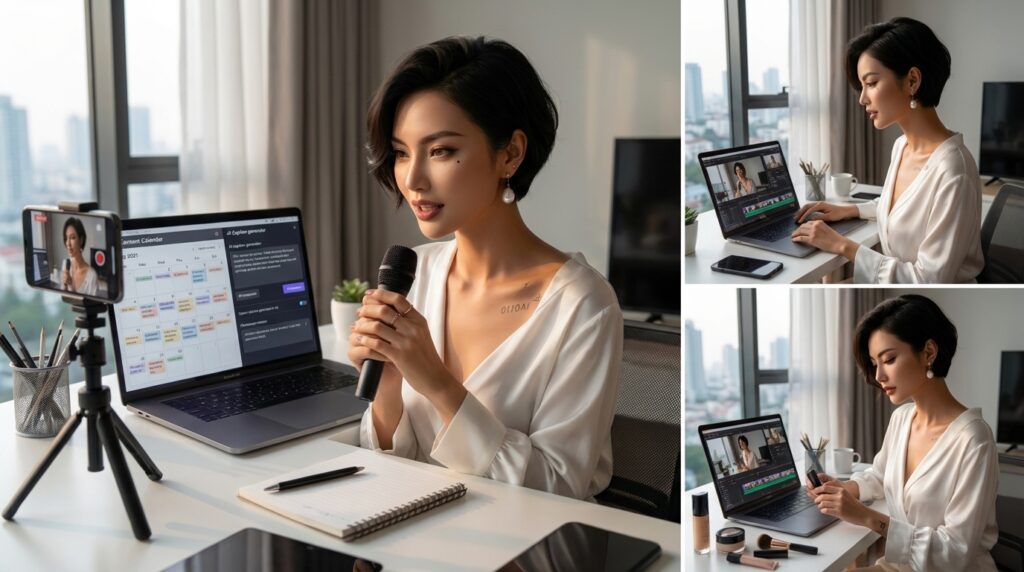
Week 3 — Optimize Content for Platform Growth
Week 3 is your live publishing week — and the moment your AI influencer content strategy moves from planning into practice. Content goes live for the first time, and your focus shifts from production to platform-specific optimisation: adapting content presentation for each platform’s algorithm, testing posting times, and beginning to repurpose your best assets across formats.
Adapt content for Instagram and TikTok
The same content requires minor presentation adjustments for each platform. Instagram captions can be longer (up to 2,200 characters) and support multiple hashtag blocks; TikTok captions should be shorter (150 characters or fewer) with hashtags integrated into the caption rather than appended at the end. Instagram Reels should include text overlay captions styled on-brand; TikTok benefits from more spontaneous-feeling text overlays that match the platform’s informal aesthetic.
For Instagram specifically, ensure every post includes a save-worthy element — a tip list, a step-by-step breakdown, or a piece of information worth bookmarking. Instagram’s algorithm weights saves heavily in its distribution decisions for content from new accounts. For a deeper breakdown of the AI tools that maximise Instagram reach and follower growth, see our guide to the best AI tools for Instagram growth.
Test posting times and formats
During Week 3, post at the scheduling tool’s recommended best time for your audience’s time zone. Track the engagement rate of each post within the first 60 minutes — this early engagement window is the primary signal the algorithm uses to decide whether to distribute the post more widely. Note the exact posting time and early engagement score for each post in a simple tracking document.
Also test one alternative format for an existing content idea. If your planned post is a single image, try the same content as a two-slide carousel. If a planned Reel is scripted and narrated, try a text-overlay version without voiceover. Week 3 is your first opportunity to generate real performance data — treat it as a structured experiment rather than just a publishing schedule.
Repurpose long content into short clips
Any content from Week 2 that runs longer than 60 seconds — or any carousel with four or more slides — is raw material for additional short-form posts. Extract the strongest 15–20 second segment from each longer Reel and publish it as a standalone clip with a new caption. Export each carousel slide as an individual image and schedule the strongest slides as separate feed posts with adapted captions.
This repurposing approach multiplies the output of your Week 2 production session by two to three times without additional creative work. It also improves platform coverage — a carousel that performs well on Instagram may reach a different audience segment when its strongest slide is published as a standalone post three days later.
Week 4 — Build Engagement Loops and Community
By Week 4 you have two weeks of posting history and enough data to begin making evidence-based strategy adjustments. This week’s focus shifts from production and optimisation to community building — the engagement habits and storytelling techniques that convert followers into loyal, active audience members.
Encourage comments and interaction
End every caption with a specific, frictionless question that your audience can answer in one to three words. Avoid open-ended questions that require thought — “What’s your go-to morning routine?” is harder to answer than “Morning coffee or tea?”. Low-friction questions drive comment volume; comment volume is an algorithmic distribution signal. Build a library of 30 to 40 niche-specific engagement questions using ChatGPT and draw from it for every caption.
Reply to every comment within the first hour after a post goes live. This early comment activity window is when the algorithm is most attentively watching whether a post is generating real engagement. A single personalised reply to each early comment takes five to ten minutes and significantly increases the likelihood of broader algorithmic distribution.
Use storytelling to increase retention
Introduce narrative continuity into your content calendar. Reference previous posts: “Last week I showed you [X] — here’s what happened next”. Build multi-part educational series that reward followers who catch every instalment. Give your character recurring opinions, interests, and experiences that come up across multiple posts and Stories.
Narrative continuity does two things simultaneously: it rewards long-term followers with the feeling of being part of an ongoing story, and it gives new profile visitors a reason to scroll back through your archive. Both behaviours — return visits from existing followers and deep dives from new visitors — are strong algorithmic signals that improve distribution over time.
Analyze performance and refine strategy
At the end of Week 4, run your first full analytics review. In Metricool or your scheduling platform’s dashboard, identify your top three posts by reach, your top three by saves, and your top three by comments. Note the format, content pillar, posting time, and caption structure of each. For the complete system covering how high-output AI creators analyse and respond to their performance data, see our guide to how AI influencers create content every day.
Use these patterns to plan Month 2. If Reels consistently outperform static posts in reach, add a third Reel per week. If educational carousels earn three times more saves than lifestyle posts, weight Month 2’s production toward educational carousels. Data-driven content planning is what separates accounts that grow strategically from those that grow by chance.
30 Content Ideas for Beginner AI Influencers
Use the following 30 content ideas as starting prompts for your first month of posting. Each is designed to be adapted to any AI influencer niche by substituting your specific topic area into the idea framework.
Daily lifestyle post prompts
- Character’s morning routine — a styled image series showing the character’s morning environment
- Outfit of the day — character in a niche-relevant outfit with a short opinion caption
- Current obsession — one thing the character is into this week, with a recommendation
- Aesthetic mood board — a carousel of visual references that define the character’s current aesthetic
- Day-in-the-life Story series — five to seven Stories walking through the character’s day
- Character opinion post — a bold statement from the character’s point of view on a niche topic
- Favourite things — a list post of the character’s top five tools, products, or habits in the niche
Behind-the-scenes content ideas
- How the character is created — a brief walkthrough of the AI tools and process behind the account
- Content creation process — a screen recording or step-by-step Story showing how a post is made
- Bloopers or outtakes — AI image or video generation outputs that didn’t make the final cut
- Tool spotlight — a short Reel showcasing one AI tool the account uses, with a use-case example
- Before and after — the raw AI output versus the finished, branded post side by side
- Prompt reveal — sharing the exact Midjourney or ChatGPT prompt behind a popular post
- Monthly reflection — what worked, what didn’t, and what the character is changing next month
Educational micro-content topics
- Three beginner mistakes in [niche] — a carousel with one mistake per slide and a correction
- Quick tips for [specific niche outcome] — a five-tip Reel with one tip per cut
- Tool comparison — two AI tools for the same task, with a clear recommendation
- Step-by-step tutorial — a carousel walking through one complete process in six to eight slides
- Common myths debunked — three niche misconceptions corrected in a punchy Reel
- Beginner’s glossary — a carousel defining the five most confusing terms in the niche
- Resource roundup — the five best free tools or resources for beginners in the niche
Trend-based short video ideas
- Trending audio adaptation — use a current top Instagram or TikTok audio track with a niche-specific on-screen text overlay
- Day-in-the-life Reel — a fast-cut montage of character scenes set to trending music
- POV format — “POV: you’re a [niche] AI influencer in 2026” with a scripted voiceover
- This or that poll Reel — two opposing niche preferences with a call to comment
- Get ready with me — character ‘getting ready’ for a niche-relevant event or activity
- Reaction format — character reacting to a common niche opinion with a twist ending
- Transformation Reel — before/after using an AI tool or technique relevant to the niche
- Expectation vs. reality — a split-screen format comparing a niche assumption with the reality
- Hot take — a bold, debatable opinion from the character with a question prompt in the caption

Simple Repurposing Workflow for Faster Growth
A repurposing workflow multiplies the output of each production session without proportionally increasing the time invested. Every piece of content you produce has at least two to three additional format variations that can be published across platforms over the following days. Building repurposing into your standard production process from Week 1 is the single most time-efficient growth strategy available.
Turn posts into Reels and Shorts
Any educational carousel or list post can be adapted into a Reel by narrating each slide as a 5–10 second clip. Feed the carousel slide copy into ChatGPT: “Convert these carousel slides into a 30-second Reel script for [platform]. Maintain the same educational value, but adapt the format for fast-paced video.” Generate the Reel in HeyGen or D-ID, edit in CapCut, and publish within two to three days of the original carousel.
This carousel-to-Reel conversion is the most efficient repurposing move available to AI influencer accounts because it turns your highest-saving content format (educational carousels) into your highest-reach format (short-form video) — serving different algorithmic distribution mechanisms with the same underlying content.
Convert videos into image carousels
Any scripted Reel with five or more distinct points can be reverse-repurposed into an educational carousel. Extract the key points from the script, build a slide for each in Canva using your brand template, and publish the carousel two to four days after the original Reel. Add a cover slide with a strong hook headline and a closing slide with a clear call to action.
This video-to-carousel conversion serves a different audience segment than the Reel — people who prefer to read rather than watch, who save content for later, and who discover posts through search and hashtags rather than the Reels feed. Publishing both formats from the same content brief doubles your audience reach per idea without doubling your production time.
Reuse captions across platforms
Any caption written for Instagram can be adapted for TikTok, LinkedIn, and Pinterest with minimal editing. After writing an Instagram caption in ChatGPT, follow up with: “Adapt this caption for [TikTok / LinkedIn / Pinterest] — maintain the core message but adjust length, tone, and hashtag approach for each platform.” For the complete multi-platform AI content production system that covers repurposing at scale, see our guide to the AI content creation workflow for beginners.
Analytics Checklist for Monthly Content Improvement
A monthly analytics review converts four weeks of posting data into a concrete, evidence-based strategy for the month ahead. Run this checklist at the end of each month using your scheduling platform’s analytics dashboard.
Key engagement metrics to track
These are the four metrics that most directly predict AI influencer account growth and monetisation potential:
- Reach per post — how broadly each piece of content is being distributed; low reach indicates algorithm distribution issues, usually caused by inconsistent posting or weak early engagement
- Engagement rate — the percentage of reached users who interact; target 3–5% for Instagram, 5–10% for TikTok; below this suggests a mismatch between content and audience
- Save rate — the percentage of reached users who save; the strongest quality signal on Instagram; educational and value content should consistently exceed 1–2%
- Weekly follower growth rate — net new followers per week as a percentage of total followers; should trend upward month-over-month in a healthy account
How to identify high-performing content
Sort your posts by each of the four metrics above and identify the top three posts in each category. Look for overlap — posts that appear in the top three across multiple metric categories are your strongest all-round performers and the clearest signal of what your audience values most. Note the format, content pillar, posting time, caption structure, and hashtag set of each top performer.
Compare your top performers to your lowest performers across the same metrics. Identify the structural differences: did top performers use a stronger opening hook? Were they posted at a different time? Did they belong to a specific content pillar? The contrast between your best and worst performers usually reveals one or two specific variables that account for the majority of performance variation.
When to adjust posting strategy
Make strategic adjustments after four weeks of data, not before. Single-week performance variation is too influenced by external factors — platform algorithm changes, trending topics, seasonal audience behaviour — to draw reliable conclusions from. Four weeks of data reveals patterns that are specific to your account and audience rather than to external variables.
Adjust one variable at a time when you do make changes. If your educational carousel posts consistently outperform lifestyle posts, add one more educational carousel per week and hold all other variables constant for the next four weeks before evaluating. Changing multiple variables simultaneously makes it impossible to identify which change drove the improvement.
Frequently Asked Questions
Here are answers to the most common questions beginners have about developing an AI influencer content strategy.
How often should AI influencers post?
Four to five feed posts per week plus daily Stories is the recommended starting frequency for a new AI influencer account on Instagram. This volume is enough to build consistent algorithmic distribution momentum without requiring daily live production sessions — a weekly batching workflow handles it in 60 to 90 minutes. Add two to three Reels per week for accelerated follower growth.
On TikTok, one to two videos per day is the recommended frequency for new accounts in their first 90 days. TikTok’s algorithm rewards high posting volume more aggressively than Instagram, and the production time per TikTok is lower than for Instagram Reels. Use cross-posting from your Instagram Reel production to cover TikTok without doubling your production workload.
What content works best for virtual influencers?
The highest-performing content formats for AI influencer accounts in 2026 are educational carousels (highest save rates), short-form Reels using trending audio (highest reach and new follower acquisition), and personality-driven lifestyle posts (highest comment engagement). Accounts that combine all three formats in their weekly content mix consistently outperform those that focus exclusively on any single format.
Niche matters significantly for format performance. Fashion and lifestyle AI influencers see their strongest performance from styled static images and aesthetic Reels. Technology and finance AI influencers see strongest performance from educational carousels and tutorial Reels. Test the content mix in your specific niche for four weeks before drawing conclusions about which formats work best for your account.
Can beginners follow a 30-day content plan?
Yes — the 30-day plan in this guide is specifically designed for beginners with no prior content creation or social media management experience. Each week has a single, clear focus, and each task is supported by specific AI tool recommendations and ChatGPT prompt templates. The production workflow requires no design, video editing, or copywriting skills.
The most challenging aspect for most beginners is not the technical execution but the consistency discipline — maintaining the weekly batching sessions and posting schedule through the first 30 days when growth is still slow. The accounts that complete the full 30-day plan almost always see meaningful audience growth in month two, because the foundation built in month one begins compounding from the first week of month two.
Which tools help automate content strategy?
The essential automation tools for an AI influencer content strategy are:
- ChatGPT — content ideation, script generation, caption writing, and repurposing across all platforms
- Canva — branded template library that applies visual consistency automatically to every new design
- Later or Buffer — automated post scheduling with best-time-to-post recommendations
- Metricool — automated weekly analytics reports covering reach, engagement, saves, and follower growth
- Flick — AI hashtag research that generates optimised hashtag sets for each content topic
- CapCut — AI video editing templates that reduce Reel production time to minutes
Next Step — Build Long-Term AI Influencer Growth
The 30-day plan in this guide is the starting point of a long-term AI influencer content strategy — not the complete picture. Month one builds the foundation: a defined persona, an established visual identity, a working production workflow, and the first set of real performance data. Month two is where the compounding begins: data-driven content improvements, increased Reel production, and the first monetisation moves.
For the complete roadmap covering every stage of AI influencer brand building beyond the first 30 days — from niche selection and avatar creation through monetisation and scaled production systems — see our ultimate guide to how to become an AI influencer in 2026. It covers the ten-step framework that this 30-day plan feeds into, including platform strategy, analytics optimisation, brand partnerships, and the production scaling systems that allow a solo creator to build a high-output account without proportionally increasing their time investment.
A well-executed AI influencer content strategy does not just produce content — it builds compounding momentum that makes every post more valuable than the one before it. Commit to the four-week plan, execute each week’s tasks in sequence, and review your analytics honestly at the end of Week 4. The data from your first 30 days is the most valuable strategic asset your account will ever generate — it tells you exactly what your specific audience responds to, in your specific niche, at your specific stage of growth. Every decision from month two onwards should be built on it.