AI influencers create content every day not through endless creative energy, but through structured workflows and automated tools that turn a complex production process into a repeatable daily routine. Understanding how they do it is one of the most practical lessons any aspiring creator can learn in 2026.
The defining difference between AI influencers who grow consistently and those who stall is not talent or budget — it’s systems. The most successful AI-powered creators rely on a proven AI influencer workflow: AI image and video generators for visuals, AI writing tools for scripts and captions, and scheduling platforms that distribute content automatically across multiple platforms without manual effort.
This guide breaks down exactly how AI influencers structure their AI social media production system, the specific tools they use at each stage, and how beginners can apply the same approach to build a consistent, professional content presence from scratch. Whether you’re building a personal brand, launching a niche account, or managing content for a business, the AI content automation routine translates directly to any creator context.
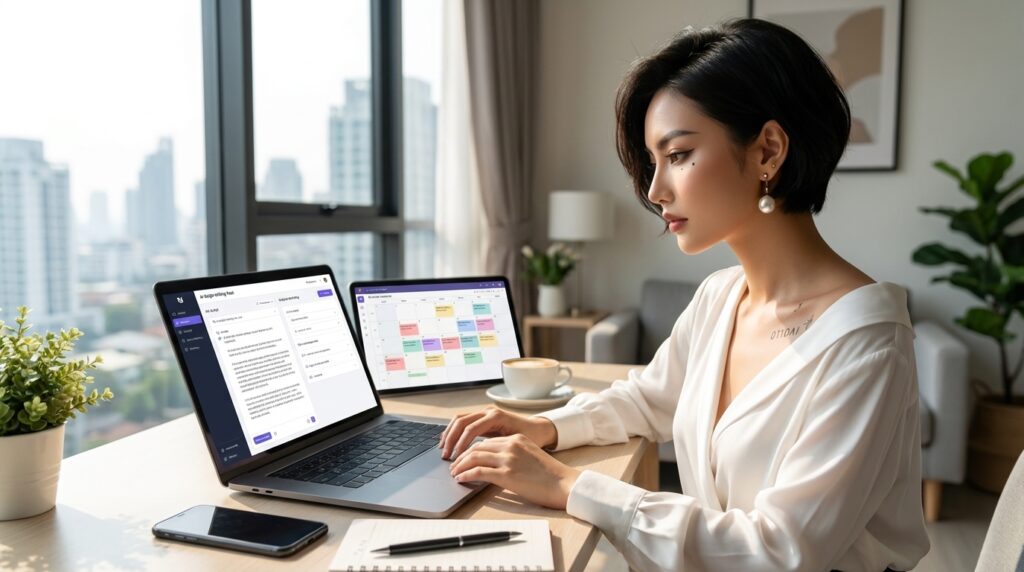
An AI influencer content workflow is a structured system that uses artificial intelligence tools to plan, create, edit, and publish content consistently. It allows creators to produce daily content efficiently by combining automation, batching, and strategic content planning.
What You Will Learn in This Guide
In this AI influencer workflow guide, you will learn:
- how AI influencers create content every day
- how to structure a repeatable content workflow
- which tools power daily content production
- how to maintain consistency without burnout
- how to scale content into a growth system
What Is an AI Influencer Content Workflow
An AI influencer workflow is a structured daily routine that combines AI tools, pre-built templates, and automated scheduling to produce, edit, and distribute content consistently — without the time overhead of unstructured, manual creation. It is the operational backbone behind accounts that post daily across multiple platforms while maintaining visual and tonal consistency.
This workflow is not just about creating content daily — it is part of a larger system where strategy, consistency, and analytics drive long-term growth. If you want to understand the full picture before diving into the daily mechanics, start with this guide on how to become an AI influencer to see how each component connects.
How AI Influencers Create Content Every Day Using Structured Workflows
Most AI influencers operate on a batching and automation model rather than creating content in real time. A typical AI content automation routine involves a weekly planning session where ideas, scripts, and visual briefs are generated in bulk using AI tools, followed by daily micro-sessions of 20–30 minutes for final reviews, personalisation, and publishing.
This separation of creation and distribution is what makes daily posting sustainable. The heavy creative work — ideation, scripting, image generation, caption writing — is done in concentrated sessions once or twice a week. The daily routine is lightweight: review, adjust, and confirm the day’s scheduled content rather than creating from scratch each morning.
Why consistency matters for audience growth
Instagram, TikTok, and YouTube all reward accounts that post consistently with greater algorithmic distribution. Accounts that post every day, or on a reliable schedule, are shown to more users and grow their follower base faster than accounts that post sporadically, regardless of individual post quality.
Beyond the algorithm, consistency builds audience habit. Followers who know when to expect new content from a creator engage more deeply over time — saving, sharing, and commenting at higher rates than the casual followers of inconsistent accounts. The compounding effect of consistent posting is one of the most reliable growth mechanisms available to any content creator.
Types of content AI influencers produce
A well-rounded AI social media production system typically covers multiple formats to maximise reach across platforms:
- Feed posts — polished static images or carousels for Instagram, Pinterest, and LinkedIn
- Short-form video — Reels, TikTok clips, and YouTube Shorts between 15 and 90 seconds
- Stories — daily behind-the-scenes, polls, Q&As, and interactive content
- Long-form content — YouTube videos, blog posts, or podcast episodes published weekly
- Brand collaboration content — sponsored posts, product integrations, and affiliate promotions
- Community content — replies, duets, stitches, and community-building posts
How to Use This Workflow
If you are just starting:
→ Follow the daily workflow step-by-step
If you want faster content:
→ use batching and templates
If you want better results:
→ focus on editing and branding
If you want to scale:
→ connect workflow with full growth system
Core AI Tools Used by AI Influencers
The AI influencer workflow is built around four categories of tools that cover every stage of content production. Most successful AI influencers use one to two tools per category, mastering a small stack deeply rather than spreading effort across dozens of platforms.
AI tools for script and content ideas
Idea generation and scripting tools are the starting point for every piece of content in an AI content automation routine. The most widely used:
- ChatGPT — generates content ideas, post concepts, video scripts, and full caption drafts from a brief niche and audience description
- Claude — strong for long-form script writing and content with a natural, conversational tone; useful for YouTube scripts and newsletter copy
- Jasper — dedicated content marketing platform with brand voice settings and built-in templates for social media scripts and ad copy
- AnswerThePublic — surfaces real audience questions around any topic, providing an endless supply of relevant content angles
AI image and video generation tools
Visual content is the core output of most AI social media production systems. These tools handle image generation, video creation, and editing:
- Midjourney — the leading AI image generator for creating high-quality, stylised visual content; widely used for feed post imagery and thumbnail creation
- DALL·E — OpenAI’s image generator, accessible directly through ChatGPT; strong for realistic and illustrative imagery with fast iteration
- CapCut — the most popular free AI video editor for short-form content; includes auto-captions, AI effects, trending templates, and direct TikTok and Instagram integration
- Runway ML — professional AI video generation platform capable of producing video clips from text prompts or still images; used for high-production-value Reels and brand content
- Canva AI — template-based design with AI image generation, background removal, and Magic Edit; the most accessible all-in-one visual tool for non-designers
AI caption writing and hashtag tools
Caption writing and hashtag research tools ensure every post in the AI influencer workflow is optimised for engagement and discoverability:
- ChatGPT — the most flexible caption writing tool; a single prompt produces a full caption with hook, body copy, call to action, and hashtag set
- Predis.ai — dedicated Instagram and social media content tool that generates captions, hashtag sets, and complete post designs from a text brief
- Flick — AI hashtag research tool that identifies high-performing, niche-relevant hashtag sets for Instagram and TikTok
- Writesonic — social media caption templates for Instagram, TikTok, LinkedIn, and Facebook with tone and audience customisation
AI scheduling and automation platforms
Scheduling and automation tools complete the AI content automation routine by distributing content across platforms without daily manual effort:
- Later — visual Instagram and TikTok scheduler with AI best-time-to-post recommendations and a content calendar view
- Buffer — clean multi-platform scheduler supporting Instagram, TikTok, YouTube, LinkedIn, and Pinterest with AI caption assistance
- Metricool — strong free plan with cross-platform scheduling, analytics, and competitor benchmarking
- Hootsuite — enterprise-grade scheduling with AI content suggestions, bulk scheduling, and comprehensive analytics
While ChatGPT is best for ideation and scripting, tools like CapCut and Canva are essential for visual production, and scheduling platforms handle distribution efficiently.
Consistent content production using AI workflows directly supports monetisation through audience growth, brand deals, and digital products. To build the income layer on top of your workflow, review this AI influencer monetization strategy guide. And to understand how daily output connects with your positioning and audience, the AI influencer content strategy guide covers how to make every piece of content work toward a larger goal.
Daily Workflow: How AI Influencers Create Content
The following five-step AI influencer workflow represents the core daily production routine used by AI influencers across Instagram, TikTok, and YouTube. The full AI social media production system takes 30–60 minutes on active creation days and as little as 15–20 minutes on days when scheduled content only needs a final review before going live.
Many influencers also rely on AI content creation workflow for beginners to structure their publishing routine.
Step 1 – Generate content ideas and scripts
Each content session begins with an idea and script generation prompt in ChatGPT. A reliable starting prompt: “Give me 5 content ideas for a [niche] account on [platform]. For each idea, provide a working title, a 3-bullet content outline, and a suggested hook for the caption or video opening.”
From the ideas generated, select the one that best fits the current day’s content slot on your calendar. If creating video content, follow up with a script prompt: “Write a 30-second script for a [platform] video about [topic] for [audience]. Start with a strong hook, keep the pacing fast, and end with a clear call to action.” Save all unused ideas to your content ideas bank for future sessions.
Step 2 – Create visuals using AI tools
With your script or content brief confirmed, move to visual creation. For static image posts, open Midjourney or DALL·E and generate your image from a detailed prompt. For templated graphics — quote posts, carousel slides, announcement graphics — open Canva and apply your brand template.
For Reels and short-form video, import your footage or AI-generated clips into CapCut. Apply a trending template that matches your content style, adjust the cuts and transitions, and sync to the selected audio track. CapCut’s AI template engine handles the technical editing work, reducing the video production step to a matter of minutes.
Step 3 – Edit content and add branding
Once your visual or video is assembled, apply your brand elements. In Canva, this means applying your Brand Kit — colours, fonts, and logo — to ensure the finished post matches your account’s established visual style. In CapCut, add your watermark, brand colour overlays, and consistent text styling.
Review the finished visual at its intended display size. Feed posts should be reviewed at thumbnail scale to ensure they remain legible and visually impactful when competing with surrounding content in a user’s feed. Make any final adjustments before moving to caption creation.
Step 4 – Write captions and hashtags
With your visual complete, generate your caption in ChatGPT. An effective caption prompt: “Write an Instagram caption for a post about [topic]. Brand voice: [tone]. Include a hook as the opening line, two to three lines of value, a question or call to action, and 10 relevant hashtags.”
Review the generated caption and add one personal or brand-specific detail that the AI wouldn’t have — a timely reference, a personal experience, or a specific statistic. This light personalisation is what distinguishes engaging AI-assisted content from generic, templated output. It typically adds two to three minutes to the caption step but significantly improves engagement.
Step 5 – Schedule and publish posts
Upload your finished visual and caption to your scheduling tool — Later, Buffer, or Metricool. Use the platform’s best-time-to-post recommendation to set your posting time, add location and topic tags where relevant, and schedule. For accounts managing multiple platforms, repeat the upload step for each platform, adjusting caption format and hashtag volume to match each platform’s conventions.
Once scheduled, add the content idea and key performance notes to your content tracking document. Noting the topic, format, posting time, and expected content type takes under a minute and creates the data you’ll need later to identify which content types consistently outperform others with your specific audience.

Types of Content AI Influencers Create Every Day
A high-output AI social media production system typically spans four to five content formats, distributed across platforms to maximise audience reach and engagement. Each format serves a different purpose in the content mix and requires slightly different tools and production approaches.
Instagram posts and Stories
Instagram feed posts — both single-image and carousel formats — are the foundation of most AI influencer accounts. Feed posts provide permanent, searchable profile content that continues to earn impressions and profile visits long after publishing. Carousels, in particular, earn some of the highest save rates of any Instagram format because they deliver substantial value in a swipeable, easy-to-revisit format.
Stories complement feed posts by providing daily touchpoints that keep an account visible in followers’ feeds even on days without a new feed post. AI influencers typically produce Stories using quick Canva templates, AI-generated text content, and Instagram’s native interactive features — polls, question boxes, and emoji sliders — to drive daily engagement.
Short-form videos for Reels and TikTok
Short-form video is the highest-reach format available to AI influencers in 2026. Instagram Reels and TikTok both actively surface short-form content to non-followers through their discovery feeds, making them the most effective format for growing a new audience quickly. A single Reel or TikTok that resonates with the algorithm can generate more new followers than weeks of static post content.
AI influencers produce short-form video using CapCut for editing and effects, ChatGPT for scripts and on-screen text, and AI image or video generators for b-roll and background visuals. The production time for a finished Reel — from script to exported file — is typically 15–25 minutes using this AI content automation routine.
Behind-the-scenes content and lifestyle posts
Behind-the-scenes and lifestyle content humanises an AI influencer account and builds the authentic connection that drives long-term follower loyalty. For AI influencers, this content typically shows the creative process: how images are generated, how scripts are written, which tools are used, and what the AI influencer workflow looks like in practice.
This type of content performs particularly well as Stories and casual Reels because it satisfies audience curiosity about how AI content is actually made. It also requires the least production effort of any content format — screen recordings, process walkthroughs, and unpolished behind-the-scenes clips connect with audiences precisely because of their low-production, authentic feel.
Promotional and brand collaboration content
As AI influencer accounts grow, brand collaboration opportunities emerge. Sponsored content, affiliate promotions, and product integrations represent the primary monetisation channel for most AI influencer accounts with established audiences.
AI tools make brand collaboration content production efficient: ChatGPT generates compliant, on-brand ad copy from a product brief; Canva produces polished sponsored post graphics using brand assets provided by the partner; CapCut creates sponsored Reel content using product footage or AI-generated visuals. The same AI social media production system applies to collaboration content with the addition of brand guideline review and approval steps before publishing.
Tips to Maintain a Consistent AI Content Routine
The daily workflow is the foundation — but sustaining it over weeks and months requires specific habits that protect consistency under the real-world pressures of busy schedules, creative fatigue, and platform algorithm changes. These four strategies are the most effective for long-term AI content automation routine sustainability.
Batch content creation workflows
Batching is the single most important habit for maintaining daily posting without daily burnout. Dedicate one or two sessions per week — typically 60–90 minutes each — to producing all of the content for the following five to seven days. During a batching session, run all idea generation, visual creation, caption writing, and scheduling in sequence for multiple posts at once.
The efficiency gain from batching is significant. The cognitive overhead of starting a content creation session — opening tools, loading prompts, getting into a creative flow — is incurred once per batching session rather than once per post. Over a week, this alone saves 30–60 minutes of effective working time compared to creating each post individually on the day it’s due.
Using templates and reusable prompts
Templates and saved prompts are the second pillar of a sustainable AI influencer workflow. For visual content, build a library of Canva brand templates — one for each post format you use regularly — so that every new piece of content starts from a pre-styled, on-brand foundation rather than a blank canvas.
For AI text generation, maintain a prompt library document containing your best-performing prompts for idea generation, scripting, caption writing, and repurposing. Reusing proven prompts is faster than writing new ones and produces more consistent output quality. Update and refine your prompt library every two to four weeks based on which prompts produce the most usable content with the least editing.
Tracking performance and optimizing content
A content routine without performance tracking is flying blind. Review your analytics weekly using your scheduling platform’s dashboard — Later, Buffer, and Metricool all provide engagement breakdowns by post type, format, and posting time. Look for the patterns that tell you what your specific audience responds to most.
Use these patterns to shape your batching sessions. If carousel posts consistently earn more saves than single images, weight your next batch toward carousels. If Reels posted on Tuesday mornings outperform those posted on weekends, shift your scheduling accordingly. Optimisation based on real audience data is more reliable than any general best-practices advice.
To continuously improve based on data, track your content performance using this guide on analyzing AI influencer performance metrics.
Building a recognizable visual style
Visual consistency is one of the most powerful growth accelerators for AI influencer accounts. When every post in your feed uses a consistent colour palette, font set, and compositional style, new visitors immediately recognise the account as intentional and professional. This visual coherence increases follow rates from profile visits significantly.
Use Canva’s Brand Kit to lock in your colour palette, fonts, and logo and apply them automatically to every template. For AI-generated images, develop a set of Midjourney or DALL·E style prompts that consistently produce imagery matching your brand aesthetic — and reuse those style descriptors in every image generation prompt. Consistency of style is more important than novelty of content for early-stage account growth.
To understand how visual identity connects to broader audience positioning, the AI influencer positioning strategy guide explains how to define and communicate your unique creator angle across every piece of content you produce.

Frequently Asked Questions
Here are answers to the most common questions about how AI influencers create and maintain their daily content workflows.
How do AI influencers create content daily?
Most AI influencers do not create content from scratch every day. Instead, they batch-produce content in two or three weekly sessions, using an AI content automation routine to compress ideation, scripting, visual creation, and caption writing into a concentrated workflow. Scheduling platforms then distribute the pre-created content daily without further manual input.
The daily routine for most AI influencers is therefore a 15–20 minute review session — checking that scheduled content looks correct, responding to comments, and reviewing analytics — rather than a full production session. The production work happens in batches; the daily routine is primarily management and engagement.
Which tools do AI influencers use most?
The core AI influencer workflow toolkit in 2026 consists of:
- ChatGPT — for content ideas, scripts, captions, and repurposing
- Midjourney or DALL·E — for AI image generation
- CapCut — for short-form video editing and Reel production
- Canva — for branded graphic templates and visual design
- Later or Buffer — for scheduling and analytics
Most AI influencer accounts operate effectively on this five-tool stack. Specialised tools — Runway ML for cinematic video, Flick for hashtag research, Predis.ai for automated post generation — are added as the account grows and production volume increases.
Can beginners follow an AI influencer workflow?
Yes — the AI influencer workflow is designed to be beginner-accessible. Every tool in the core stack has a free plan that covers the essential features, and the five-step daily workflow described in this guide requires no design skills, video editing experience, or technical background.
The learning curve is primarily about developing effective prompts and building familiarity with your chosen tools. Most beginners reach a comfortable, repeatable production pace within two to four weeks of consistent daily practice. Starting with one platform and one content format, then expanding, is the most sustainable approach for creators new to the workflow.
Is AI content creation fully automated?
The production and distribution parts of the AI social media production system are largely automatable — scheduling tools publish posts at preset times without manual input, and AI tools can generate complete posts from a single text prompt. However, fully automated content without human review and personalisation consistently underperforms content that includes a human editing pass.
The most effective approach is to automate the repetitive, mechanical elements — scheduling, formatting, initial drafting — while keeping human judgment involved in ideation, personalisation, and quality review. This hybrid AI influencer workflow produces content that is both fast to create and genuinely engaging for real audiences.
Getting Started with Your Own AI Influencer Workflow
Building your own AI influencer workflow starts with one decision: choose one platform, one content format, and one posting frequency you can commit to for the next 30 days. Consistency over a month builds more momentum than sporadic bursts of high-volume posting.
Set up your core toolkit this week: ChatGPT for ideas and captions, Canva for visuals, CapCut for any video content, and Later or Buffer for scheduling. Run through the five-step AI content automation routine once with a single post. The first run-through will reveal where your workflow needs refinement — which prompts produce the best output, which visual style fits your brand, which scheduling times work for your audience.
If you’re building out a broader content production system beyond social media, see our guide to AI tools for beginner video creators for a complete breakdown of the best AI platforms for video editing, captioning, and multi-platform publishing in 2026.
To understand how daily content fits into long-term growth, follow this AI influencer growth roadmap — it maps the phases from consistent posting to audience growth to full monetisation. The AI influencer growth system then shows how to connect your workflow to each growth layer systematically, so that every piece of content you produce moves you measurably closer to your goals.
The creators who grow fastest are not those with the most sophisticated tools — they’re the ones who commit to a simple, repeatable AI influencer workflow and execute it consistently. Start simple, batch early, and let the data from your first weeks of posting guide every decision from there.
Learning how to build an AI influencer workflow is one of the most important steps toward creating a scalable content system and long-term online income.