
Follower count tells you how many people discovered your brand. Fan loyalty tells you how many of them decided it was worth keeping. The difference is not a minor distinction — it is the primary variable that separates AI influencer accounts with compounding growth from those that plateau despite strong content output. An AI influencer loyalty strategy is the operational system that closes the gap between passive discovery and active, long-term fan investment.
Passive followers consume content when the algorithm serves it. Loyal fans seek it out, share it with context, advocate for the brand in community spaces, and convert on premium offerings without extensive persuasion. A community of 10,000 loyal fans consistently outperforms a passive audience of 100,000 in every commercially meaningful metric — engagement depth, word-of-mouth reach, and revenue per follower.
Loyalty is also the advanced stage of retention. While retention keeps followers from leaving, loyalty transforms them into active participants who compound brand value over time. This article maps the complete framework for developing fan loyalty systematically — connecting directly to any audience retention strategy already in place and building on it toward full brand moat development.
AI influencer loyalty strategy is the process of turning passive followers into long-term fans through emotional investment, recognition systems, community participation, advocacy pathways, gamification, personalisation, and fan identity development.
A strong AI influencer loyalty strategy helps creators increase retention, build superfans, improve engagement depth, grow through organic advocacy, strengthen monetisation potential, and create a defensible long-term brand moat.
In a crowded AI influencer market, loyalty also becomes a competitive strategy because accumulated trust, shared history, advocacy behaviour, and fan identity are harder to copy than individual content formats or visual styles.
What You Will Learn in This Guide
In this AI influencer loyalty strategy guide, you will learn:
- how loyalty differs from retention and passive engagement
- how the 6-phase superfan development ladder works
- how to design recognition systems, ambassador pathways, and advocacy loops
- how gamification and personalisation deepen emotional fan bonds
- how loyal fans increase growth, monetisation, and audience lifetime value
- how to measure loyalty impact using engagement, advocacy, and revenue signals

AI Influencer Loyalty Strategy: Strategic Overview
Loyalty is not a state that followers arrive at spontaneously. It is a progression through increasingly deep brand relationship stages — each of which requires specific design to facilitate the transition to the next. Understanding loyalty as a developmental system rather than a personality trait that some followers happen to have allows creators to engineer its conditions rather than hope it emerges.
The compounding case for loyalty investment is clear: each month a fan remains actively invested in the brand, their conversion probability increases, their advocacy value grows, and their resistance to competitive attention strengthens. The return is not immediate — but it is long-term, compounding, and more structurally durable than any paid distribution strategy.
Loyalty vs retention — the key distinction:
| Retention | Loyalty |
|---|---|
| Keeps followers from leaving | Transforms followers into active participants |
| Reduces churn | Creates brand advocates |
| Sustains existing engagement depth | Deepens emotional investment over time |
| Defensive system | Compounding growth engine |
Why long-term fan relationships drive exponential growth
Long-term fans function as distributed brand infrastructure. They create content within the brand’s aesthetic universe, recruit new audience members through personal recommendation, defend the brand in public spaces, and sustain community engagement between the creator’s posting cycles.
The network mechanism: each highly loyal fan typically influences three to seven people in their social graph toward the brand over the course of a year. At a community of 5,000 loyal fans, this creates a passive recruitment pipeline that can exceed the creator’s own organic reach on any given platform — an effect that no algorithm can replicate. Understanding how engagement behaviour signals translate into loyalty progression helps creators identify which fans are approaching the threshold for active advocacy.
Understanding the psychology of superfans
Superfans are followers whose relationship with the brand has become identity-relevant. They experience the brand’s success as personally meaningful, feel genuine emotional investment in the persona’s narrative, and derive social meaning from their community membership.
Fan loyalty is also an audience psychology system. Superfans are created through familiarity, emotional resonance, identity alignment, recognition, and the feeling that their participation matters to the AI persona’s story.
This identity relevance develops through four factors:
- Narrative depth — the more there is to invest in, the more investment is likely
- Recognition quality — from both the creator and peer community members
- Identity expression — the degree to which community membership allows authentic self-expression
- Accumulated shared history — the relationship that deepens through time and shared experience
Signals that indicate loyalty progression
Loyalty progression is measurable through behavioural signals, not self-reported sentiment. Primary progression indicators:
- Transition from algorithmic discovery to active seeking — follower visits the profile directly
- Comment quality evolution from reactive to participatory — initiating conversations rather than reacting
- Cross-platform following behaviour across all brand channels
- Community space participation independent of specific content posts
- Spontaneous brand advocacy in the follower’s own content or conversations
Loyalty metrics should be reviewed alongside engagement benchmarks so creators can separate normal content variation from a real decline in advocacy, participation, or fan trust.
These signals allow creators to segment audience by loyalty stage and design calibrated interventions rather than applying uniform tactics across an audience at different relationship depths.
Section Summary: Loyalty is the compounding layer above retention. It converts followers into brand advocates who generate growth, cultural production, and commercial conversion independent of the creator’s active involvement.
The 6-Phase Superfan Development Ladder
The superfan development ladder maps the progressive stages through which a casual follower can be guided toward deep, durable fan loyalty. Each phase has distinct psychological conditions and creator behaviours that accelerate the transition to the next phase.
A loyalty strategy becomes stronger when it is supported by community strategy. Fans are more likely to become advocates when they have rituals, peer relationships, shared spaces, and visible roles inside the community.
Phase 1 — Awareness and Discovery
The primary loyalty objective at this stage is not engagement — it is memorability. The follower needs to leave the first encounter with enough impression of the brand’s aesthetic, narrative identity, and positioning clarity to return voluntarily.
High awareness-to-follow conversion brands share three characteristics:
- An immediately identifiable visual aesthetic creating a distinct first impression
- A content hook in their most-surfaced content that communicates core narrative or personality clearly
- A profile architecture that rewards exploratory scrolling with evidence of depth and community activity
Phase 2 — Engagement Activation
The engagement activation phase converts a recent follower into a habitual content consumer through pattern establishment. The follower develops an expectation of what the brand delivers, when, and why continued following is worth their attention.
Consistent content pillar execution is the primary driver here — not posting volume, but posting predictability within a clearly defined scope. Followers who can form accurate mental models of what to expect from a brand develop habitual return behaviour more reliably than those encountering varied content without structural consistency. A clear content strategy framework is the operational foundation for this predictability.
Phase 3 — Emotional Commitment Conversion
This is where habitual followers begin developing genuine investment in the brand’s narrative and community. Conversion triggers that accelerate this transition:
- A narrative event with personal emotional resonance that makes the follower feel something specific
- A moment of direct personal recognition that makes the individual follower feel seen by the creator
- A community interaction that creates a positive social experience with other brand community members
None of these need to be large-scale. A personalised reply, a community thread that generates genuine conversation, or a narrative vulnerability moment in a story post can each serve as a commitment trigger.
Phases 4–6 — Identity Investment, Active Advocacy, Cultural Co-creation
The later phases represent escalating levels of brand relationship depth. Identity investment is when following the brand becomes part of how the follower expresses themselves. Active advocacy is when they begin recruiting others into the community through genuine personal recommendation. Cultural co-creation is when they begin producing content and community contributions that expand the brand’s cultural footprint independently.
Building the systems that facilitate progression into these later phases — the recognition pathways, participation mechanics, and community governance structures — is the core design challenge of a mature loyalty strategy. A well-structured growth system connects these loyalty phase transitions to the brand’s broader audience development architecture.
Section Summary: Each phase of the development ladder has a specific psychological mechanism and a targeted creator action that accelerates the transition. Mapping your current audience against these phases identifies exactly where to invest retention and loyalty effort.
Designing Advocacy and Ambassador Pathways
Advocacy is the highest-expression form of fan loyalty — the stage at which a fan’s relationship with the brand extends beyond their own experience to actively shaping others’ relationship with it. Each new advocate operates as an independent brand amplifier at no operational cost.
Encouraging community leadership roles
Community leadership roles give fans with high identity investment a way to express loyalty through contribution rather than just consumption:
- Community moderators — maintain culture and standards of community spaces
- Creative contributors — produce fan-generated content formally recognised and amplified by the brand
- Knowledge curators — organise and maintain community resource libraries
- Cultural ambassadors — represent the brand’s values in adjacent community spaces
The investment effect is key: a fan who has built community culture has a stake in that culture’s continuation that a passive consumer does not. Their retention becomes partly driven by their desire to see their investment valued and maintained.
Creating recognition systems that reward loyalty
Recognition is one of the most powerful and underused loyalty drivers. Being individually acknowledged by a brand they admire is a significantly positive experience for most fans — and one they are highly likely to share with others, creating organic advocacy moments from a low-cost creator action.
Recognition forms:
- Formal: Monthly fan features, milestone acknowledgements, community contribution awards
- Informal: Personalised comment replies, reactive acknowledgement of fan-created content, direct messages to long-term community members on significant occasions
Both generate the same psychological response: the sensation of being valued creates emotional reciprocity — a felt obligation to continue supporting something that has demonstrated it values your participation.
Developing peer-to-peer promotion loops
Peer-to-peer loops are the organic sharing mechanisms through which fan advocacy generates new audience discovery without creator involvement. They are most active when three conditions are met:
- The fan has a genuine positive emotional experience they want to share
- The sharing format is easy and socially natural in their context
- Their social graph will find the recommendation credible based on the brand’s known identity
Design participation formats that are inherently shareable: community challenges with results fans want to showcase, milestone achievements worth documenting and sharing, and cultural moments fans experience as identity-expressing rather than just content-consuming.
Section Summary: Advocacy pathways convert invested fans into brand growth infrastructure. Recognition is the highest-ROI loyalty tool available — formal systems amplify it; consistent informal practice sustains it.
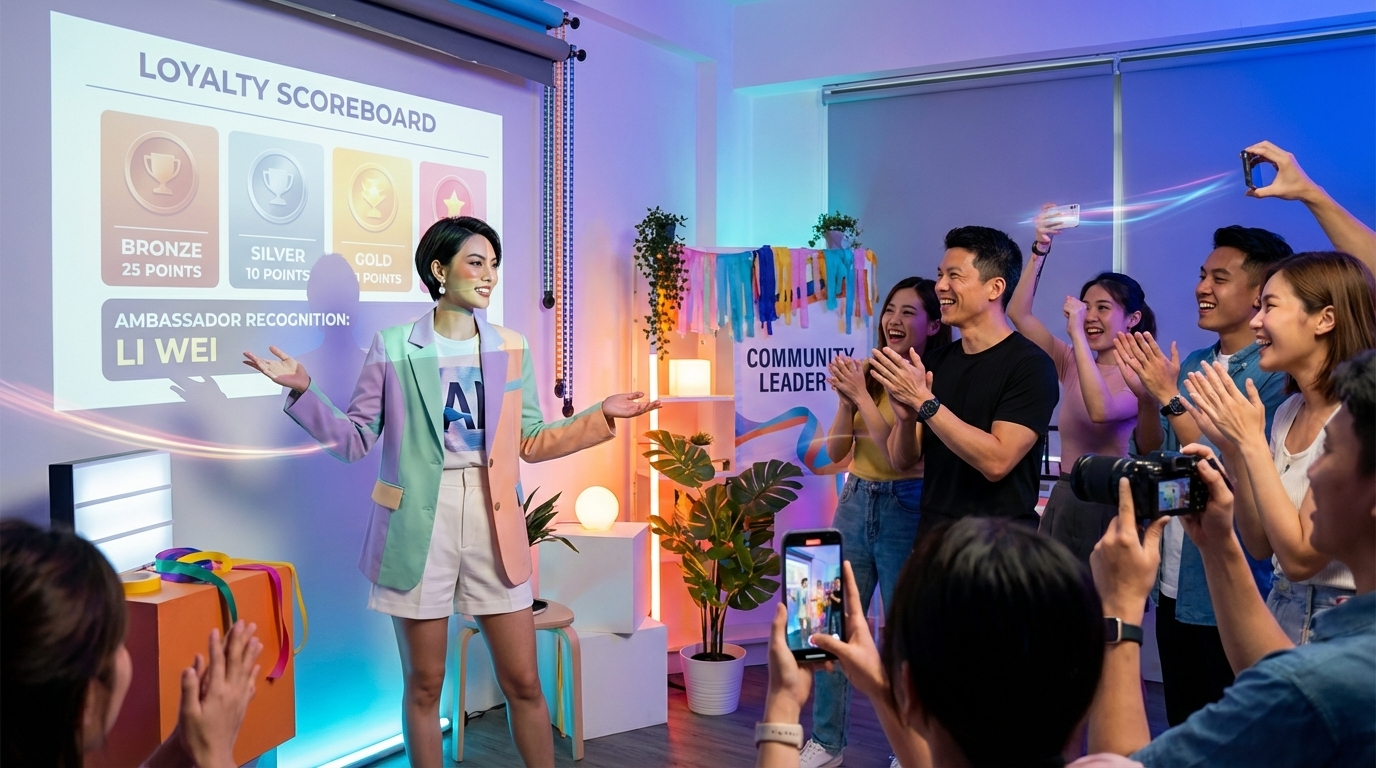
Gamification and Reward Multipliers for Fan Retention
Gamification applies game design principles — progression, rewards, achievement, and social visibility — to the fan relationship in order to increase the sustained engagement that builds and maintains loyalty. When designed well, gamification transforms passive engagement into active participation by giving fans a sense of progress, accomplishment, and earned status.
Tiered loyalty programmes and VIP access
Tier design should be based on meaningful access differentiation — not arbitrary badge accumulation:
| Tier | Access Level | Example Benefits |
|---|---|---|
| Entry | General community | Early content access, community recognition |
| Mid | Elevated access | Direct creator interaction, exclusive content series |
| Top | Co-creator status | Brand decision participation, visible community status |
Tiers serve dual functions: giving current members reasons to stay engaged (to maintain their tier status) while giving lower-tier members visible aspiration toward higher-tier access.
Exclusive content drops and symbolic milestones
Exclusive drops are culturally significant release events that create shared fan experience moments. Their retention value comes from two sources: the content delivers exclusive value reinforcing that deep community engagement is worth maintaining, and the shared experience of receiving and reacting together creates community bonding that deepens collective identity.
Symbolic milestones — follower count achievements, narrative arc completions, anniversary events — are opportunities to create fan experience moments that commemorate shared history. When handled well, these become cultural reference points that long-term fans carry as part of their relationship with the brand.
Participation scoreboards that motivate engagement
Participation scoreboards create positive social competition around involvement. The critical design constraint: scoreboards should recognise quality of engagement rather than raw interaction volume. A single deeply thoughtful comment should register as more valuable than twenty single-word reactions — or the system incentivises the wrong behaviours.
Section Summary: Gamification works by making loyalty progression visible and rewarding. Tier systems create both retention incentives and aspiration ladders. Scoreboards amplify participation only when they reward depth, not volume.
Personalisation Systems That Strengthen Emotional Bonds
Personalisation transforms mass audience relationships into individual-quality connections. When a fan experiences the brand as responsive to their specific presence rather than broadcasting to an undifferentiated audience, the emotional quality of the relationship shifts — from admiration at a distance to genuine mutual recognition.
Mapping individual fan journeys using analytics insights
At the community level, fan journey mapping means segmenting the audience by engagement depth and tenure, identifying the most active cohorts, and designing creator interactions calibrated to each cohort’s loyalty stage.
At the individual level, it is the practice of noticing specific fans’ engagement patterns — the topics they consistently respond to, the formats they reliably engage with, the community spaces they are most active in — and designing recognition moments that acknowledge these specific patterns rather than delivering generic appreciation. This approach to long term audience development is what differentiates brands that build genuine relationships from those that manage follower counts.
Automating interaction without losing authenticity
Effective automation maintains authenticity through three principles:
- Personalise at the variable level, not the template level — automated responses including the specific content piece or community contribution being acknowledged feel personal even when delivered systematically
- Reserve genuine creator presence for highest-value interactions — the long-form comment demonstrating real thinking, the unexpected personal acknowledgement of a milestone
- Communicate creator involvement in community design — fans understand that the systems serving them reflect genuine creator investment even when individual interactions are managed by team processes
Balancing aspiration with relatability in storytelling
The emotional dynamic sustaining deepest fan loyalty combines aspiration and relatability. Too much aspiration without relatability creates admiration without attachment. Too much relatability without aspiration reduces the brand to peer-level content without the elevation that makes following feel meaningful.
The balance: aspirational content should dominate reach-generation formats where new audiences first encounter the brand, while relatable content should be proportionally higher in community-facing spaces where existing fans are the primary audience.
Section Summary: Personalisation at scale is achievable through variable-level automation, journey-mapped recognition, and the aspiration-relatability balance that creates emotional accessibility without sacrificing brand elevation.
Turning Superfans into Organic Growth Engines
Superfans are not just the most retained audience segment — they are the most powerful growth mechanism available. When superfans advocate, they generate new audience exposure through the highest-credibility channel: personal endorsement from someone whose taste the new audience already trusts.
Designing referral and advocacy funnels
Effective fan referral funnels have three elements:
- A clear referral invitation — a specific action fans can take when recommending the brand
- A strong landing experience — converting referred new visitors into followers through a strong first impression
- A recognition mechanism — acknowledging the referring fan for their recruitment contribution
Referral systems work most naturally when embedded in fan experience moments rather than presented as marketing asks. Community challenges, exclusive experiences, and milestone events all serve as organic referral mechanisms without requiring explicit asks.
Amplifying fan-created content ecosystems
Fan-created content combines the brand’s aesthetic identity with the authentic personal endorsement of someone the new audience knows. Amplifying this content serves multiple functions simultaneously:
- Rewards the fan’s creative investment, increasing their loyalty and motivation to continue
- Signals to other fans that creative contribution is valued, increasing the overall rate of fan content creation
- Generates brand exposure through channels the creator does not directly control
Develop clear amplification protocols: a specific hashtag or mention mechanism for easy discovery, a regular creator practice of acknowledging and sharing the most culturally coherent fan creations, and community spaces where fan content is celebrated between members independent of creator involvement.
Leveraging emotional ownership for brand expansion
Emotional ownership is when fans feel a genuine stake in the brand’s trajectory — part of what the brand is becoming, not just observers of it. This creates a brand expansion dynamic in which the fan community actively participates in growth through recruitment, cultural production, and advocacy rather than waiting passively for the creator to push it through content output alone.
Emotional ownership develops through genuine participatory mechanisms: community governance involvement, co-creative opportunities, narrative participation, and documented acknowledgement that the community’s contributions have shaped the brand’s direction. The advocacy driven growth research across the broader creator industry consistently confirms that emotional ownership communities outperform passive follower bases on every growth and retention metric.
Section Summary: Superfans are growth infrastructure, not just retained followers. Design referral mechanics, amplify fan-created content, and build genuine participatory pathways to activate the organic growth engine that loyal fan communities generate.

Measuring Loyalty Impact on Growth and Revenue
Loyalty is commercially valuable in ways that are often underestimated because the mechanisms are less direct than paid acquisition. Building measurement frameworks that capture loyalty’s actual impact is essential for making rational investment decisions about the systems described in this article.
Loyalty is one of the strongest drivers of audience lifetime value because loyal fans buy more often, stay longer, refer others, upgrade into higher-value offers, and participate in community systems over a longer relationship window.
Loyalty strengthens monetisation strategy because loyal fans require less persuasion, trust recommendations more deeply, and convert more consistently on memberships, digital products, affiliate offers, and premium community experiences.
Strong loyalty also increases brand authority because loyal fans remember, recommend, defend, and validate the AI influencer brand more consistently than passive followers.
Tracking fan lifetime value indicators
Fan lifetime value is the cumulative commercial and growth contribution a single loyal fan generates over their active relationship with the brand. It includes:
- Direct revenue: Digital product purchases, membership subscriptions, exclusive drops
- Indirect revenue: Brand partnership conversion influence, referrals that reduce acquisition cost
- Cultural contribution: Fan-created content, community building activity, advocacy reach
Key lifetime value indicators to track by audience cohort:
| Indicator | What It Reveals |
|---|---|
| Revenue per follower: loyalty vs exploration stage | Monetisation multiplier of loyalty investment |
| Tenure correlation with product conversion rate | How long until a follower’s commercial value compounds |
| Advocacy-generated new followers per cohort | Organic growth efficiency of loyalty depth |
| Membership tier upgrade rate by tenure | Depth of loyalty progression in the audience |
Comparing engagement depth vs follower size
The accounts generating the most commercial value per follower are rarely the largest. They are the accounts with the highest proportion of followers in advanced loyalty stages.
The benchmark comparison to run quarterly: compare your top 10% most engaged audience cohort against your average follower. If the gap is large — five to ten times higher engagement rate, significantly higher cross-platform following, ten times higher product conversion rate — your loyalty architecture is functioning. If the gap is small, the loyalty progression mechanisms are not yet differentiating superfans from casual followers.
Analysing advocacy-driven reach expansion
Advocacy-driven reach is the audience growth generated through fan referral, fan-created content, and peer-to-peer recommendation rather than creator content distribution. Measuring this separately from algorithmic reach provides a clear signal of loyalty system performance.
Track through:
- Referral source data for new followers — % arriving through tagged fan content or direct recommendation
- Organic brand mention volume in contexts where the creator is not the source
- Correlation between community engagement events and new follower acquisition spikes not explained by algorithmic distribution changes
Common Loyalty Strategy Mistakes AI Influencers Make
Ignoring fan recognition and appreciation rituals
The most common and most easily corrected loyalty failure is the systematic absence of fan recognition. Most creators focus on content production and platform growth while treating community acknowledgement as an afterthought. Recognition rituals — scheduled, deliberate practices of acknowledging and celebrating fan contribution — generate loyalty returns that consistently exceed their operational cost. A weekly fan feature or a policy of personally responding to first-time comments from new community members represent high-return, low-cost loyalty investments.
Over-automating relationship-building processes
Over-automation produces a discernible inauthenticity that erodes the personal relationship quality that loyalty depends on. The boundary is between automating the delivery of genuine creator investment (acceptable) and automating the investment itself (corrosive). Systematic fan recognition automates delivery. Fully scripted engagement with no genuine creator presence automates investment — and engaged fans can feel the difference.
Inconsistent persona storytelling and brand values
Fans who have developed deep identity investment in a persona’s narrative experience unexpected shifts in voice, aesthetic, or story logic as betrayal — the relationship they built was with a specific character, and that character is no longer reliably present. Managing persona evolution as deliberate, communicated narrative development — rather than reactive adjustment to trend pressure — is the primary defence against narrative inconsistency-driven loyalty collapse.
Future of AI Influencer Fan Culture
As loyalty deepens, it often becomes brand culture. Shared language, fan rituals, inside references, symbolic milestones, and co-created content turn loyal followers into participants in a larger cultural identity.
Rise of decentralised fan communities
Fan communities are increasingly developing the infrastructure to self-organise independent of creator involvement — managing their own community spaces, producing creative content, and establishing cultural norms without constant creator direction. AI influencer brands that invest in governance infrastructure allowing decentralised communities to thrive within a coherent cultural framework will develop the most culturally resilient fan ecosystems in the category.
Hybrid AI-human creator collaborations
The boundary between AI influencer brands and human creator brands is softening as collaborative formats emerge combining the world-building depth of AI personas with the authentic real-time responsiveness of human creator involvement. These hybrid formats create fan loyalty dynamics neither pure AI nor pure human creator formats can generate independently.
Evolution of digital identity and belonging
The social role of fan community membership in providing digital identity and belonging is growing as online community structures become more central to how people find peers who share their values. AI influencer brands that design their communities as genuine belonging ecosystems — not just content delivery vehicles — are positioning themselves at the intersection of this structural social shift.
Frequently Asked Questions
How do AI influencers build superfans?
Superfan development requires moving followers through a deliberate progression: from discovery and habitual engagement, through emotional commitment conversion, to identity investment and active advocacy. The specific mechanisms that accelerate this progression are: narrative depth that gives followers something meaningful to invest in, recognition systems that make individual followers feel seen, community architecture that creates social bonds between community members, and participation formats that give fans a genuine role in the brand’s story development.
What increases long-term audience loyalty?
Long-term loyalty is sustained through four dimensions: narrative continuity (the persona’s story develops consistently and rewards ongoing attention), community depth (fans have relationships with other community members extending beyond the creator’s content), recognition quality (the creator consistently acknowledges and values fan contribution), and participation relevance (fans have genuine influence over aspects of the brand’s development they care about). The strength of loyalty corresponds to the strength of the weakest of these four dimensions.
Can loyal fans influence monetisation success?
Directly and significantly. Loyal fans convert on digital products at three to five times the rate of general audience members, renew and upgrade membership subscriptions at significantly higher rates, and generate word-of-mouth referrals that reduce acquisition cost. A community with 20% of followers in advanced loyalty stages typically generates 60–70% of total direct monetisation revenue and the majority of organic growth referrals — demonstrating that loyalty concentration, not follower count, is the primary monetisation driver.
How do you reward engaged followers effectively?
The most effective reward systems combine formal recognition structures (tiered access, milestone acknowledgements, public feature opportunities) with informal genuine appreciation (personalised creator responses, unexpected acknowledgements of long-term engagement, creative contribution amplification). The critical design principle: rewards should feel earned, not automatic. Recognition that requires genuine contribution has higher loyalty impact than participation rewards available to any follower regardless of engagement depth.
Conclusion — Loyalty as the Catalyst for Sustainable Influence
The distance between a passive follower and a brand superfan is not primarily a function of time. It is a function of the deliberate systems designed to facilitate the progression between them. An AI influencer loyalty strategy that maps the superfan development ladder, builds advocacy pathways, designs gamification mechanics, personalises at scale, and measures the commercial contribution of loyalty systematically is the foundation of the compounding growth engine that sustainable AI influencer brands run on.
Fans do not develop spontaneously. They are cultivated — through recognition, narrative investment, community architecture, and consistent delivery of experiences that make ongoing brand relationship genuinely worth maintaining. The creator who invests in this cultivation early builds a competitive advantage in loyalty depth that is structurally difficult to replicate quickly, because loyalty is a function of accumulated shared history — and history cannot be accelerated.
Build the systems. Cultivate the fans. Compound the growth.
📚 Continue Learning
Deepen your AI influencer loyalty strategy with these connected resources:
- AI Influencer Audience Retention Strategy — The retention foundation that loyalty architecture builds on
- AI Influencer Growth System — Connect loyalty phase transitions to your broader brand development architecture
- AI Influencer Content Strategy — Build the content pillar consistency that drives engagement activation and habitual return
- Becoming an AI Influencer Guide — The foundational guide for creators building the brand loyalty operates on
➡️ Next Step in Your AI Influencer Growth Journey
You have the loyalty framework. The next stage is engineering the lifetime value systems that make each loyal fan more commercially productive over time.
👉 Next: AI Influencer Lifetime Value — learn how to increase the commercial value of each loyal fan through product ladders, membership tiers, community monetisation, repeat purchases, and long-term relationship depth.
Retain the follower. Deepen the loyalty. Compound the value.
Learning how to build an AI influencer loyalty strategy is one of the most important steps toward creating superfans, stronger audience retention, higher audience lifetime value, deeper community advocacy, and long-term online income.