The creator economy has moved past the era where reach alone determined influence. Follower counts are compressible — algorithms change, platforms shift, and audiences that were algorithmically served can disappear just as fast. What cannot be disrupted is AI influencer brand culture: the shared identity, rituals, language, and emotional investment that transform a passive audience into an active community that carries the brand’s meaning independently of any platform’s distribution mechanics.
The distinction matters more in 2026 than ever before. A content strategy tells you what to post and when. A brand culture strategy tells you what your community believes, how they participate, and why they recruit others. The two are not interchangeable — and creators who conflate them consistently underestimate why some brands of equivalent size have ten times the engagement, loyalty, and commercial leverage of others.
This article maps the complete framework for building a cultural movement ecosystem around an AI influencer brand: from narrative mythology and identity codex development, through ritual systems and memetic strategy, to governance models and long-term cultural trajectory. The cultural layer is what your long term growth roadmap is ultimately building toward — and it is the compounding layer that makes every other brand investment more durable.
AI influencer brand culture strategy is the process of turning an AI creator brand into a shared digital culture through narrative mythology, visual identity, rituals, community language, fan participation, symbolic content, and long-term audience ownership.
A strong AI influencer brand culture strategy helps creators move beyond reach and engagement by building a fandom movement that increases loyalty, retention, brand authority, monetisation potential, and long-term platform resilience.
In a crowded AI influencer market, brand culture becomes a competitive strategy because competitors can copy formats and visuals, but they cannot easily copy shared mythology, community memory, insider language, and identity-based loyalty.
What You Will Learn in This Guide
In this AI influencer brand culture strategy guide, you will learn:
- how AI influencer brand culture differs from content strategy
- how origin mythology and identity systems create fandom behaviour
- how rituals, symbols, and community language deepen audience loyalty
- how transmedia storytelling expands culture across platforms
- how fan governance and cultural ownership strengthen retention
- how brand culture supports monetisation, authority, and long-term growth

AI Influencer Brand Culture: Strategic Overview
Brand culture is the set of shared meanings, behaviours, aesthetics, and stories that a community develops around a creator brand over time. It is not manufactured in a single campaign — it is cultivated through consistent, intentional design of the conditions that allow cultural formation to occur.
An AI influencer brand with strong culture does not just have followers — it has participants. People who co-create meaning, spread symbols and language organically, and experience genuine belonging through their association with the brand. That participation is the compounding growth engine that no paid distribution can replicate. Understanding the foundations of brand building fundamentals provides useful context before mapping those principles to the specific dynamics of the AI creator space.
Brand culture becomes more valuable when it improves audience retention. If community members keep returning, referencing old stories, participating in rituals, and following the brand across platforms, the culture is no longer just aesthetic — it is becoming a retention system.
Brand culture vs content strategy — the core distinction:
| Content Strategy | Brand Culture Strategy |
|---|---|
| Defines what you post | Defines what your community believes |
| Optimises for reach and engagement | Optimises for identity adoption and belonging |
| Creator is the sole value source | Community becomes a co-equal value source |
| Growth dependent on publishing cadence | Growth operates independently of posting frequency |
| Disrupted by algorithm changes | Resilient to platform and algorithm shifts |
From personal brand to cultural movement
The transition from personal brand to cultural movement is a threshold, not a gradual shift. At the personal brand level, audiences follow because they value the creator’s perspective, aesthetic, or entertainment. At the cultural movement level, audiences participate because they value their membership in the community and the identity it represents.
The strategic implication: a cultural movement has growth mechanics that operate independently of the creator’s publishing cadence. Community members recruit new participants, create content within the brand’s aesthetic framework, and sustain engagement between posts. The creator becomes the gravitational centre of a self-propagating ecosystem rather than the sole content engine of a passive audience.
Why fandom identity drives organic growth
When an audience member adopts a brand’s identity as part of their own self-expression — referencing it in their own content, advocating for it in community spaces, recruiting friends into it — they become a distribution node. Every piece of identity-aligned content they produce exposes the brand to their own audience through the highest-trust channel available: personal recommendation and demonstrated identity affiliation.
The exponential dynamic emerges because fandom identity is self-reinforcing. More participants increase the perceived social value of membership, which increases the conversion rate of new audience members into active community participants. Understanding the audience psychology principles that drive this identity adoption is essential before attempting to engineer it.
Signals of strong brand culture formation
Culture is measurable before it becomes visible at scale. Early formation signals:
- Audience members using the brand’s specific phrases in their own content
- Unsolicited fan art or creative work in the brand’s aesthetic
- Community-generated nicknames or collective identity terms
- Sharing patterns where members tag specific friends rather than broadcasting broadly — recruiting within their social graph, not posting for the algorithm
Section Summary: Brand culture and content strategy are fundamentally different systems. Culture creates growth mechanics — identity adoption, community recruitment, and platform resilience — that content volume alone cannot produce.
Origin Mythology and Narrative Foundations
Every enduring cultural brand has a founding mythology: a story of origin that explains not just what the brand is, but why it exists and what it stands for. For AI influencer brands, the origin mythology is particularly rich — the story of how an AI persona came to exist, what purpose it serves, and what it seeks to achieve provides a narrative canvas far more expansive than most human creator brands can access.
Creating meaningful character backstories
A character backstory for an AI influencer is not a biography — it is a foundational myth that audiences can project meaning onto and creators can draw from across years of content. The most culturally resonant backstories contain four archetypal elements:
- Origin condition: Where the persona came from and why
- Defining tension: The challenge or contradiction that drives the persona’s existence
- Mission or aspiration: What the persona is working toward
- Shadow elements: Complexity or vulnerability that creates emotional depth
Layer these gradually across content rather than explaining them exhaustively in a single post. Audience members who invest attention in understanding the persona’s deeper story should feel rewarded — and that feeling of being “in on” the backstory creates cohesion among those who share that knowledge.
Using storytelling arcs to deepen audience connection
Arc-based storytelling gives a brand’s content timeline continuity and direction. Viewers who have followed for six months see meaning in the current post that new followers cannot access yet — a structural reward for ongoing participation.
Effective arc structures for AI influencer brands:
- Seasonal cycles tied to real-world calendar events
- Evolution arcs documenting the persona’s visible growth over time
- Challenge arcs where the persona navigates difficulty with audience participation
- World-building arcs that gradually expand the fictional universe across multiple content pieces
Transforming vulnerability into cultural symbolism
Vulnerability in brand storytelling is the acknowledgement of struggle, contradiction, or uncertainty — not as weakness, but as the condition that makes the story emotionally honest. For AI personas, vulnerability is particularly powerful because it subverts the expectation of digital perfection: an AI persona that expresses authentic complexity is surprising, memorable, and deeply human in its cultural impact.
Specific moments of narrative difficulty become cultural reference points — events the audience frames as significant in the brand’s story and returns to as shared experience. These cannot be manufactured formulaically, but they can be created intentionally by allowing genuine narrative stakes into your storytelling rather than maintaining a performance of consistent positivity.
Section Summary: Mythology is the foundational layer of brand culture. Build it as a four-element narrative structure, deploy it in layers, and create genuine narrative stakes that give community members reference points to return to.
Visual and Verbal Identity Codex Development
A cultural brand is expressed as much through its aesthetic system as its narrative content. The identity codex is the documented set of visual and verbal rules that define how the brand looks, sounds, and speaks — creating the recognisable surface through which cultural membership is signalled and participation is identified.
Designing recognisable aesthetic signatures
Aesthetic signatures operate at a level below conscious processing — they are not just brand colours and fonts but specific compositional choices, colour relationships, lighting moods, and stylistic quirks that recur consistently enough to become cultural markers.
The goal: a community member should recognise your content within one second — before seeing the handle, before reading the caption, before the video plays two frames. That speed of recognition means the brand’s presence in any feed is instantly legible regardless of who shared it. Your positioning strategy provides the strategic foundation for this aesthetic decision-making — ensuring visual choices express positioning intent rather than arbitrary style preferences.
Establishing consistent tone and voice patterns
Brand voice in a cultural context extends beyond caption style. It includes:
- The specific vocabulary the brand uses and avoids
- Characteristic sentence rhythms and rhetorical patterns
- The emotional register that defines how the brand expresses warmth, wit, or seriousness
- Recurring phrases or constructions that community members learn to identify as distinctively the brand’s own
Voice becomes cultural when it propagates: when community members begin using the brand’s characteristic phrases in their own content or in how they describe the brand to others. This propagation is the signal that voice has crossed from brand identity into cultural language.
Building symbolic visual language
The most powerful brand symbols in creator culture are deceptively simple — a specific colour palette, a recurring visual motif, a signature pose — because simplicity enables easy reproduction and reference by community participants. Complexity locks symbolism inside professional production; simplicity releases it into community hands.
Identify two or three visual elements with high cultural adoption potential: aesthetically distinctive, easily replicable without professional tools, and meaningfully connected to the brand’s narrative identity. Deploy them consistently until they reach recognition saturation in your community.
Section Summary: The identity codex operationalises your cultural identity into reproducible rules. When audiences can reproduce your aesthetic in their own content, your visual language has crossed into cultural territory.

Ritual Systems and Cultural Participation Mechanics
Rituals are the recurring behaviours through which communities express and reinforce shared identity. In brand culture, they create temporal markers that give community membership a rhythm, provide low-barrier participation formats for new members to signal belonging, and build collective history that deepens the community’s investment in its own continuity.
Rituals, shared language, symbolic participation, and ambassador behaviour are also the foundation of loyalty strategy. They give community members reasons to stay, participate, and recruit others beyond the value of any single post.
Weekly engagement rituals and live interaction formats
Weekly rituals are the most accessible entry point for cultural participation. A named, recurring format — a specific posting theme, a weekly question, a scheduled live session — creates anticipation and habitual return behaviour that compounds into a community calendar members can orient around.
The naming matters significantly. A generic “weekly Q&A” has low cultural adhesion. A specifically named weekly event that the community develops its own language around becomes a reference point for recruiting new participants and signalling membership history. Structured frameworks for designing and scaling these recurring touchpoints are covered in the community strategy framework, which maps participation design across community lifecycle stages.
Seasonal campaigns and symbolic digital events
Seasonal campaigns are cultural events aligned with the natural rhythms of the audience’s year — creating anticipated moments of intensified community participation. Unlike standard marketing campaigns, cultural seasonal events are designed primarily for community experience rather than external reach.
Effective seasonal event design gives the community an active role:
- A decision to make collectively
- A creative challenge to respond to
- A milestone to celebrate together
- A narrative moment to witness and interpret
The event’s cultural value is proportional to how actively the community participates in creating its meaning — not to the brand’s production quality.
Designing initiation experiences for new fans
Without deliberate initiation design, most new followers remain peripheral — aware of the community but not embedded in it, and therefore not generating the cultural participation behaviour that drives organic growth.
Effective initiation design includes three elements:
- A clear entry point — pinned post, highlighted reel, or welcome series providing access to foundational narrative and cultural markers
- A low-barrier first participation opportunity — a question to answer, a challenge to complete, a symbolic action to take
- A community recognition mechanism — acknowledging the new member’s participation and signalling their entry into the community
Section Summary: Rituals create the temporal structure and shared history that sustain community culture between content releases. Named rituals outperform generic formats in cultural adhesion by a significant margin.
Memetic Content Strategy and Symbol Creation
Memes are cultural units — discrete packages of meaning that propagate through communities by being easily shared, modified, and understood by community insiders. Memetic content strategy is the deliberate design of formats and symbols with high propagation potential: content that community members can adopt, remix, and spread, creating a distributed content creation system around the brand’s framework.
Turning content formats into repeatable cultural signals
The most culturally propagable formats are simultaneously distinctive and accessible — recognisable as belonging to the brand’s aesthetic while simple enough for community members to reproduce. A signature transition style, a characteristic caption format, a specific visual template, or a recurring structural format creates a replication pattern that spreads the brand’s visual language through community-created content.
Identify your two or three most distinctive format elements and develop simplified versions that community members can reproduce without professional tools. The goal is for community-generated content to be visually legible as part of the brand’s cultural universe — culturally coherent expressions of a shared aesthetic, not high-production reproductions.
Encouraging user-generated content ecosystems
User-generated content ecosystems develop when community members begin producing content within the brand’s aesthetic and narrative framework spontaneously — because cultural participation has become a form of self-expression for them. This requires:
- An aesthetic signature strong enough to recognise and reproduce
- A narrative universe rich enough to find meaningful to contribute to
- Sufficient community density that user-generated content receives recognition and social reward from other members
In a mature user-generated ecosystem, the creator’s role shifts from direction to curation: acknowledging and amplifying the most culturally coherent community content while maintaining enough narrative and aesthetic clarity that decentralised production remains coherent.
Amplifying viral participation loops
The basic participation loop structure:
Brand creates participation invitation (challenge, question, template) → Community responds with their own content → Brand acknowledges and amplifies the best responses → Other members see acknowledged responses and are motivated to participate → Next invitation reaches a larger, socially rewarded community
Each loop iteration should increase the social value of participation — by making acknowledgement more visible, the shared experience more referenced, or the next invitation more culturally significant than the last.
Section Summary: Memetic strategy is culture made distributable. Design formats for reproduction, build conditions for user-generated ecosystems, and engineer participation loops that reward each iteration more than the last.
Transmedia Expansion and Platform Ecosystem Growth
Transmedia expansion is the process through which a brand’s cultural universe extends across multiple platforms, creating a network of interconnected cultural touchpoints that deepen community engagement and make the brand’s presence more pervasive and multidimensional in participants’ lives.
A cultural movement becomes stronger when it is distributed through a multi-platform ecosystem, where each platform carries a different part of the story, ritual system, community identity, or monetisation path.
Building narrative continuity across platforms
Narrative continuity means that a community member who follows the brand on TikTok, Instagram, YouTube, and a newsletter experiences a connected story world — not four isolated content streams. Each platform contributes a different dimension of the narrative universe:
- Short-form video: Immediate emotional resonance and discovery
- Long-form content: Depth, complexity, and expertise development
- Newsletter: Direct intimacy and relationship depth
- Community platforms: Participant co-creation and governance
The design principle: each platform should contain content that rewards cross-platform engagement — references to events on another platform, narrative threads that develop across channels, and experiential events that require multi-platform presence to fully participate in. A follower on one platform should feel they are seeing part of the story. Following additional platforms gives them more of a world they are already invested in.
Creating cross-channel cultural touchpoints
Cultural touchpoints are the specific moments and content pieces that become reference points in the community’s shared history — events members remember, reference, and use to mark their own investment in the brand’s story over time.
Conditions that make touchpoints most likely to emerge:
- Moments of unexpected creative audacity
- Milestone events with high community participation
- Narrative reveals that shift the community’s understanding of the brand’s world
- Collaborative experiences where the community shaped the outcome
Design opportunities for touchpoint creation into your content calendar — not by scripting the moment, but by creating the conditions (narrative stakes, community participation, aesthetic intensity) in which culturally significant moments are likely to emerge. The operational infrastructure for coordinating content at this scale across channels is covered in the brand authority system and the platform coordination frameworks that support it.
Strengthening identity through immersive content universes
An immersive content universe is a brand world expansive enough that community members can explore it, discover new dimensions, and create meaning within its narrative and aesthetic framework. AI influencer brands have particularly high potential here — the fictional nature of the persona allows for world-building that human creator brands cannot access without compromising authentic public identity.
The operational requirement: consistency in world rules. The aesthetic, narrative logic, and character behaviour that community members learn to anticipate must be respected and expanded — not contradicted — by new content. Inconsistency breaks immersion and reduces community investment in the fictional universe as a stable reference world.
Section Summary: Transmedia expansion makes the brand’s cultural universe more pervasive and more invested in simultaneously. Design platform roles deliberately, create conditions for touchpoints to emerge, and maintain world consistency as the foundation of immersive depth.
Fan Governance and Cultural Ownership Models
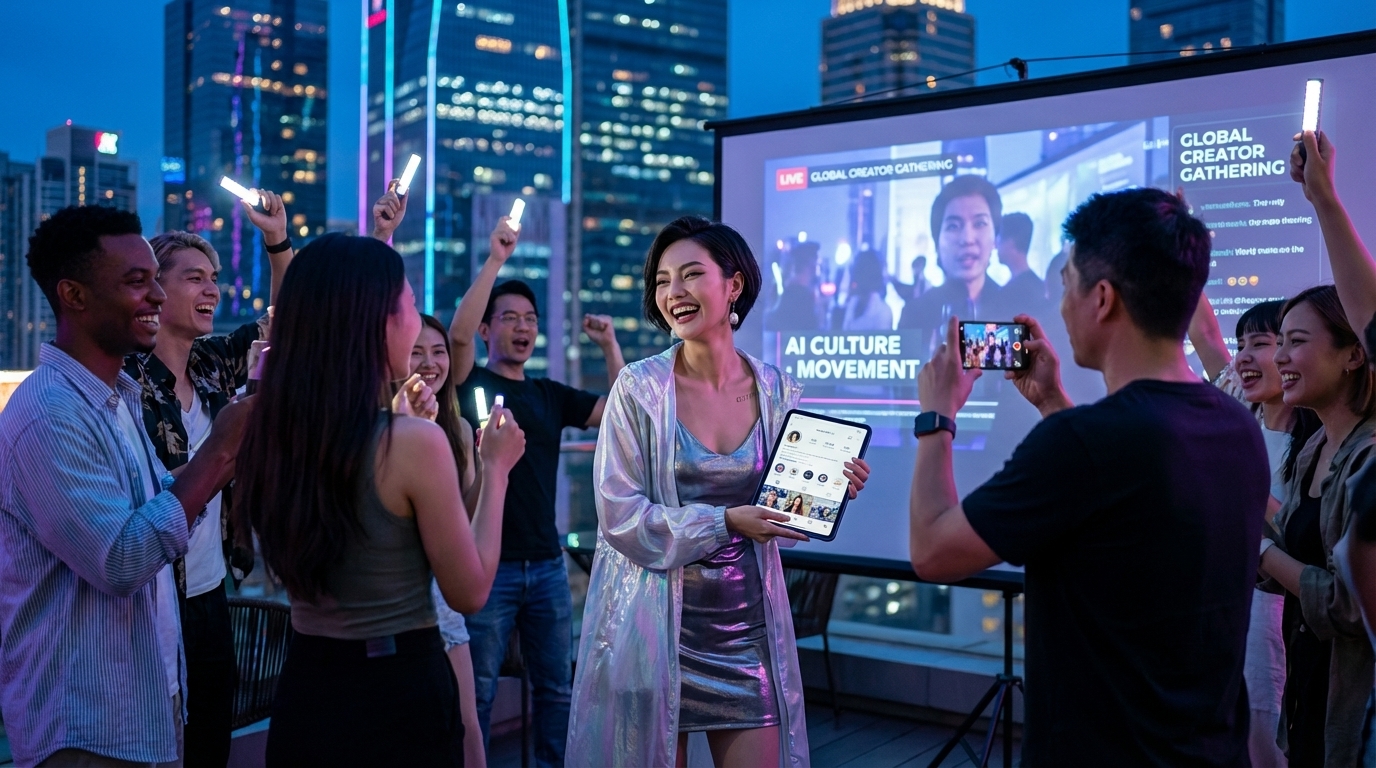
At advanced stages of cultural development, the community develops a sense of collective ownership over the brand’s cultural identity. Managing this dynamic is one of the most strategically complex aspects of cultural movement building: too much creator control limits the community’s sense of participation and ownership; too much decentralisation risks coherence and identity dilution.
Community voting systems and collaborative storytelling
Community voting systems give participants direct influence over narrative or aesthetic decisions — creating genuine co-authorship in the brand’s development. The cultural value extends beyond the decision itself: deliberating, debating, and choosing together reinforces community identity and creates shared investment in the outcome.
Effective voting system design moves from low-stakes to higher-stakes over time:
- Early stage: Which aesthetic direction for the next content series; which narrative theme for a seasonal campaign
- Mid stage: Which community initiative the brand will support; how the persona responds to a story development
- Advanced stage: Ambassador programme decisions; governance structure for community spaces
Empowering ambassadors and evangelists
Brand ambassadors in a cultural movement are not paid promoters — they are community members who have demonstrated genuine cultural investment and have the social capital to serve as cultural bridges to new audiences. This distinction is critical: fandom and brand advocacy dynamics research consistently shows that identity-driven ambassadors outperform incentive-driven ones in both authenticity and longevity.
Empowerment mechanisms for cultural ambassadors:
- Early access to brand developments and narrative information
- Direct communication channels with the creator or brand team
- Public recognition and celebration of their community contribution
- Genuine influence over community governance decisions
The ambassador relationship should feel like cultural leadership, not unpaid marketing labour.
Maintaining balance between control and decentralisation
The governance balance should shift as the community matures. Early-stage communities require more creator guidance because the cultural framework is still being established. Mature communities can handle more autonomy because the cultural norms and identity frameworks are sufficiently established to maintain coherence without constant creator involvement.
The critical principle is transparency: the community should understand what decisions the creator controls and what decisions the community influences. Ambiguity creates trust erosion when expectations about influence are not met — a particularly significant risk in mature communities with high levels of cultural investment.
Section Summary: Governance is culture’s structural layer. Move from creator-controlled to community-influenced as the culture matures — transparently, in documented stages, with ambassadors serving as the bridge between both.
Monetization Architecture Inside Cultural Movements
Cultural movements support monetization models qualitatively different from — and frequently more valuable than — those available to standard creator brands. When community members experience the brand as part of their identity rather than as content they consume, the commercial relationship shifts from transactional to participatory. Cultural monetization is not selling to an audience — it is offering the community ways to express and deepen their cultural membership.
Strong brand culture increases audience lifetime value because culturally invested fans are more likely to buy, subscribe, return, participate, and support future launches over a longer period of time.
Designing fan-supported revenue ecosystems
Fan-supported revenue flows from community members’ desire to participate more deeply — not from persuasion toward purchase. The design principle is access and participation depth rather than exclusive content alone. Paying members should receive more of what the community values: deeper narrative access, greater participation influence, closer proximity to the creator’s cultural decision-making, and visible community recognition.
Creating exclusive drops and symbolic digital assets
Effective cultural drops are tied to narrative or community milestones, limited by meaningful constraints rather than arbitrary scarcity, and designed to create community-wide shared experience rather than individual ownership privilege.
The cultural alignment test for any drop: would a deeply invested community member experience this as an expression of what the brand stands for — or as a commercial interruption? Digital assets with genuine cultural significance — visual art tied to narrative moments, symbols that have accumulated community meaning — command higher cultural and financial value than generic digital products with no narrative dimension.
Aligning brand partnerships with cultural values
Brand partnerships in a cultural movement are evaluated by the community through a cultural lens, not just a commercial one. A partnership that aligns with narrative values and aesthetic identity reinforces cultural coherence. A partnership that contradicts them erodes trust and triggers community backlash.
Partners that pass the cultural alignment test can be positioned not as sponsors but as cultural collaborators — entities that share the brand’s world and values, whose products exist naturally within the brand’s narrative universe. The full strategic architecture for cultural monetization connects to a broader AI influencer monetization framework that integrates cultural revenue streams with the complete income system.
Section Summary: Cultural monetization works because identity investment transforms commercial decisions into acts of cultural participation. Design revenue models around participation depth, not product persuasion.
Movement Scorecards and Culture Activation Roadmap
Measuring cultural momentum requires different metrics than standard creator analytics. Reach and follower growth measure distribution. Cultural metrics measure participation depth, identity adoption, and community coherence.
Cultural metrics should be reviewed alongside engagement benchmarks so creators can separate normal performance variation from a real decline in participation, loyalty, or community identity adoption.
Connecting the scorecard to an AI influencer growth system makes cultural measurement part of the same operating cycle as content planning, testing, distribution, analytics, and optimisation.
Measuring cultural engagement depth
| Metric | What It Measures |
|---|---|
| Comment depth score | Average word count and substantiveness relative to niche average |
| User-generated content rate | Volume of community-produced content inspired by the brand per week |
| Cross-platform migration rate | % of new followers on one platform who also follow on secondary platforms |
| Retention cohort analysis | % of followers from 6 months ago still actively engaging today |
Tracking symbolic adoption and participation
- Phrase and vocabulary frequency: How often community members use the brand’s signature language in their own posts and comments
- Fan art and creative content volume: Monthly volume of community-generated creative work inspired by the brand’s aesthetic
- Community self-identification: How frequently members describe themselves using brand-affiliated identity language in their own bios or profiles
- Ritual participation rate: What percentage of the community participates in weekly or seasonal ritual formats
Executing a 180-day culture rollout blueprint
Days 1–30: Foundation Establishment
- Finalise character backstory and origin mythology — write the foundational myth, not a biography
- Define the identity codex: three aesthetic signatures, five voice pattern rules, two to three core symbols
- Launch one named weekly ritual format with consistent structure
- Publish 10–15 pieces demonstrating the full cultural identity framework
Days 31–60: Participation Activation
- Introduce first community participation mechanic: named challenge, community question series, or creative prompt format
- Begin acknowledging and amplifying community-generated content publicly
- Launch first narrative arc thread: seasonal or sequential
- Initiate cross-platform cultural touchpoint strategy: reference platform-specific events across channels
Days 61–90: Cultural Reinforcement
- Identify and begin empowering first wave of community ambassadors
- Launch first exclusive cultural event or symbolic drop tied to a narrative milestone
- Introduce community voting mechanic on a low-stakes creative decision
- Assess cultural metrics against baseline: UGC rate, comment depth, cross-platform migration
Days 91–180: Movement Expansion
- Expand transmedia presence — activate additional platform with culturally coherent content
- Launch first brand partnership evaluated through cultural alignment framework
- Develop ambassador programme structure with defined roles and recognition mechanisms
- Conduct comprehensive cultural audit: symbolic adoption, ritual participation, governance health
- Design next cultural season arc based on community signals and narrative momentum data
Understanding the emotional branding dynamics on social platforms across the broader creator landscape helps calibrate realistic timeline expectations for each phase of this rollout.
Future Trends in AI Influencer Cultural Dynamics
The cultural dynamics of AI influencer brands are evolving in response to technological development, audience behaviour shifts, and the maturation of the broader AI creator ecosystem.
Evolution of digital fandom identity
Early-stage AI influencer culture operated primarily on novelty. As the category matures, novelty ceases to be sufficient — communities will increasingly demand narrative depth, aesthetic coherence, and cultural richness that sustain long-term identity investment. Creators who invest in cultural infrastructure now — mythology, ritual design, governance — will have a structural advantage as audience sophistication increases. First-mover cultural infrastructure is significantly more durable than first-mover reach.
Hybrid creator universes and immersive experiences
The boundary between AI influencer content and interactive experience is narrowing. As technology enables more responsive narrative environments, audience participation will evolve from passive engagement rituals into genuinely interactive story co-creation. AI personas whose narrative universes are designed for interactive expansion — with established world-rules and community co-authorship models — will have significantly more cultural depth than those optimised only for feed-based content consumption.
The practical implication for cultural strategy today: build world infrastructure now that can support interactive expansion later. Detailed character logic, consistent world rules, and narrative frameworks with flexibility to accommodate community co-creation.
AI-driven narrative personalisation
Narrative personalisation — customising story experience for individual community members — represents the next significant frontier in AI influencer cultural design. AI tools increasingly enable different community members to receive different dimensions of the brand’s narrative universe based on their engagement history and expressed interests.
The cultural strategy implication: design narrative systems with sufficient depth and complexity that personalisation adds value rather than fragmenting the shared community experience. Personalised dimensions must remain coherent within the shared cultural framework that gives community membership its meaning.
Frequently Asked Questions
How do AI influencers build fandom culture?
Fandom culture is built through systematic design of the conditions that allow cultural formation to occur — not through any single tactic or content piece. The core requirements are: a narrative foundation that gives community members something to invest meaning in, an aesthetic identity distinctive enough to adopt and reproduce, ritual participation formats that create habitual engagement and shared temporal experience, and sufficient community density that social rewards for cultural participation are reliably available. The process takes months of consistent execution rather than weeks of intense effort.
Why does brand culture matter for long-term growth?
Brand culture creates growth mechanics that operate independently of algorithm distribution. A culturally invested community recruits new members through organic identity-sharing, sustains engagement between posts through community interaction, and generates resilience against reach fluctuations — because the relationship between community members and the brand is identity-driven, not algorithmically mediated. These mechanics compound over time. The cultural infrastructure built at 20K followers continues generating value at 200K.
Can AI influencers create real movements?
Yes — and the AI influencer format has structural advantages that human creator brands do not access as easily. The narrative flexibility of a fictional persona allows for world-building depth and character mythology that human creators cannot sustain without compromising their authentic public identity. The ability to design cultural signals with complete intentionality — without the cognitive friction of separating personal from brand identity — enables more precise cultural engineering than most human creator brands can achieve.
How does cultural strategy affect monetization?
Cultural strength directly expands the range and value of available monetization models. Communities with high cultural investment convert at higher rates on membership subscriptions, digital products, and exclusive drops — because their purchasing motivation is identity expression rather than product utility evaluation. Long-term membership retention rates are significantly higher in culturally invested communities because membership represents identity affiliation, not just content access.
Conclusion — Turning Community into Cultural Momentum
The growth frontier beyond follower acquisition is cultural gravity: the pull that keeps communities invested, active, and expanding through their own participation rather than through platform algorithm amplification. Building AI influencer brand culture deliberately — through narrative depth, aesthetic coherence, ritual participation, memetic propagation, and governance systems that transform audiences into active cultural participants — is the compounding layer that makes every other brand investment more resilient and more valuable over time.
The frameworks in this article — origin mythology, identity codex, ritual systems, memetic strategy, transmedia expansion, fan governance, and cultural monetization — are not independent tactics. They are an interconnected cultural architecture. Narrative depth gives aesthetics meaning. Aesthetics give rituals visual coherence. Rituals give community members shared experience. Shared experience generates the user-created content that spreads the narrative to new audiences.
Start with the foundation. Build the mythology before the rituals. Establish the aesthetic before the community events. Let the cultural gravity develop through consistent, intentional design — and the movement will follow.
📚 Continue Learning
Deepen your AI influencer brand culture strategy with these connected resources:
- Long Term Growth Roadmap — Position culture-building within your complete brand trajectory
- Community Strategy Framework — Design participation systems and lifecycle mechanics for your growing community
- Audience Psychology Principles — Understand the identity adoption and belonging dynamics that drive cultural formation
- Positioning Strategy — Ensure your cultural identity is anchored in a strategic positioning foundation
- Brand Authority System — Build the credibility signals that amplify cultural momentum into market authority
➡️ Next Step in Your AI Influencer Growth Journey
You have the cultural framework. The next stage is engineering the retention systems that sustain it.
👉 Next: AI Influencer Audience Retention Strategy — learn how to design loyalty loops, re-engagement systems, community lifecycle stages, and retention mechanics that keep culturally invested audience members active over time.
Build the culture. Engineer the retention. Compound the movement.
Learning how to build an AI influencer brand culture strategy is one of the most important steps toward creating deeper fandom identity, stronger audience retention, scalable community loyalty, premium brand authority, and long-term online income.